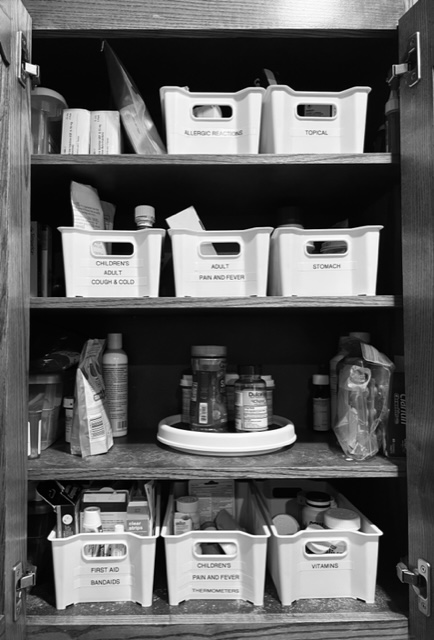
What’s in a Pharmacist Mom’s medicine cabinet?

Supplies:

I was able to get supplies off Amazon. Local stores like Walmart or Target are likely have similar options.

I decided on my bin categories and then made labels for each bin. The bins I purchased are 10 inches long, 6 inches wide and 4 inches high. I use our lazy susan spinner for quick access to medications or vitamins that our family uses every day. I have the single version. I love the double decker version and would get it if I had enough medications or high enough cabinets!

I chose categories based on our family’s needs after looking through what we keep on hand. These should be specific to your family. We have food allergies and seasonal allergies so I keep extra allergy medication on hand. We also have a kiddo that we have to watch closely to prevent constipation so we keep several of those remedies on hand also. Think about what ailments or conditions you are commonly treating for your family and include those!

This is a cabinet in our kitchen. It is not recommended to store medications in a bathroom cabinet due to the higher temperatures and humidity in bathrooms. Ours is in a corner cabinet that goes deep to the side. I keep extra things like our pill boxes, oral syringes, oral dosing cups, etc. on the inside portion that isn’t seen.

Categories:
  • First Aid, Bandaids
    • Variety of Bandaids types (waterproof, clear strips, fabric strips, etc.) and sizes
    • Butterfly strips
    • Liquid bandage
    • Triple antibiotic ointment
  • Childen’s Pain and Fever, Thermometers
    • Children’s ibuprofen
    • Children’s acetaminophen
    • Children’s acetaminophen suppositories
    • Forehead thermometer
    • Ear thermometer
  • Vitamins
    • For mom: Calcium + vitamin D, vitamin B12, biotin, collagen booster
    • For children: multivitamin, melatonin jelly beans
  • Children’s/Adult Cough and Cold
    • Delsym ages 4+
    • Throat soothing lolly pops
    • Saline nasal spray
    • Vapor rub
    • Frida baby nasal aspirator
  • Adult Pain and Fever
    • Adult acetaminophen
    • Adult ibuprofen
  • Stomach
    • Dulcolax soft chew kids
    • Dulcolax chewy fruit bites
    • Polyethylene glycol powder laxative
    • Infant’s Mylicon
    • Pepto kids
    • Adult tums
    • I also keep prescription PRNs like ondansetron in here.
  • Allergic Reactions/Allergies
    • Children’s loratadine
    • Children’s cetirizine
    • Extra Epipens (we have a food allergy kiddo)
    • Adult Benadryl
    • Adult loratadine
    • Children’s Flonase Sensimist
    • Adult Flonase Sensimist
  • Topicals
    • Hydrocortisone ointment, Compound W wart foot pads, Compund W wart Freeze Off

Each family member has a weekly pill box for traveling. I use my label maker and put a name label on the backside of each pill box. I bought my weekly pill boxes at Walmart but Amazon has similar ones available.

We also keep our pet medications in the same cabinet but off to the side. He also has a pill organizer for when he boards while we are on vacation. His is a larger version because some of his chew tablets are big. Old doggo has some arthritis and allergies too. And his pill pockets. Doggo loves his pill pockets!

Please comment with any questions or suggestions! This post does include Amazon Affiliate links to help with gathering supplies.

Here It Is! Something New.

Something new is coming. Something fun and fresh!

I’m still a practicing pharmacist. I’ve made a career change and I’m feeling less stress and more joy. I no longer operate in a role that requires me to stay in the regulatory, accreditation and legal loop like I had been. In some ways I loved it and miss it but in a lot of ways it has been a breath of fresh air!

I was burnt out. I had worked for a company that did no value their employees. No more. No more making sure I click a mouse enough to be a “good” employee – regardless if I’m reading a clinical study or participating in a meeting. click. click.

No more being asked to check in on my pharmacists for being in “restroom” code for too long – don’t worry I didn’t do that even when asked. I trust that my fellow doctorate degree employees know when they need to use the bathroom. For reals.

No more denied vacations and denied PTO for my kid’s events! No more auditing. No more “this call is recorded for quality assurance purposes”.

More joy. More real, authentic patient interactions and connections. More flexibility to be a working wife and mom. More time for my own health journey. I’m home for dinner every night. I can pick my kids up and attend their practices and games. I can take little breaks to be a kids Uber driver as needed.

Sometimes we don’t realize how unhealthy and toxic something is until we are on the other side of it.

But I’m back baby. I’m back as the best version of ME. My site will now be dedicated to motivation, wellness, pharmacy and specialty pharmacy topics. Let’s heal ourselves and the practice of pharmacy.

-PP

When Can a Pharmacy Compound?

What is compounding?

A compound is a custom medication created by the pharmacist from base ingredients for a patient.

What are the benefits to compounding?

Dose can be adjusted or customized instead of choosing the closest commercially available dose. Can create the perfect dose for a patient based on their needs, height, weight, gender, age, etc. This may reduce side effects while getting the most efficacious dose.

Commercially available medications may be made into a different dose form. Different dose forms may include tablets, capsules, ointments, creams, lozenges, oral liquid, powder, etc. Changing the dose form or route may reduce side effects or improve compliance.

May be able to create more palatable dose forms for young children and pets!

When may a pharmacy compound?

•The quantity being prepared is reasonable for filling existing prescriptions or anticipated prescriptions based on prescribing habits of local prescribers and/or prescriptions already on file

•The compounded products are not being sold to other pharmacies or third parties like a physician’s office

•The compounded product is not a compounded version of an FDA-approved drug. An exception is made if there is a shortage or no supply of a commercially available product and there is a medical need for the product. 

•The ingredients used meet the official standards found in USP/NP, are a component of an already FDA-approved drug or are on a list of approved substances developed by the Secretary of the U.S. Department of Health and Human Services

•The pharmacy does not actively promote or advertise their compounding capabilities to solicit business  

•The pharmacy does not compound a drug that has been withdrawn or removed from the market because they were unsafe or ineffective

•The pharmacy limits their interstate distribution of compounded products to not more than 5% of the total prescriptions filled at the pharmacy

Check us out on Teachable, MPJE study courses for Iowa, Maryland, Texas and Federal Law.

A New York Times Best Seller and the ANDA Process

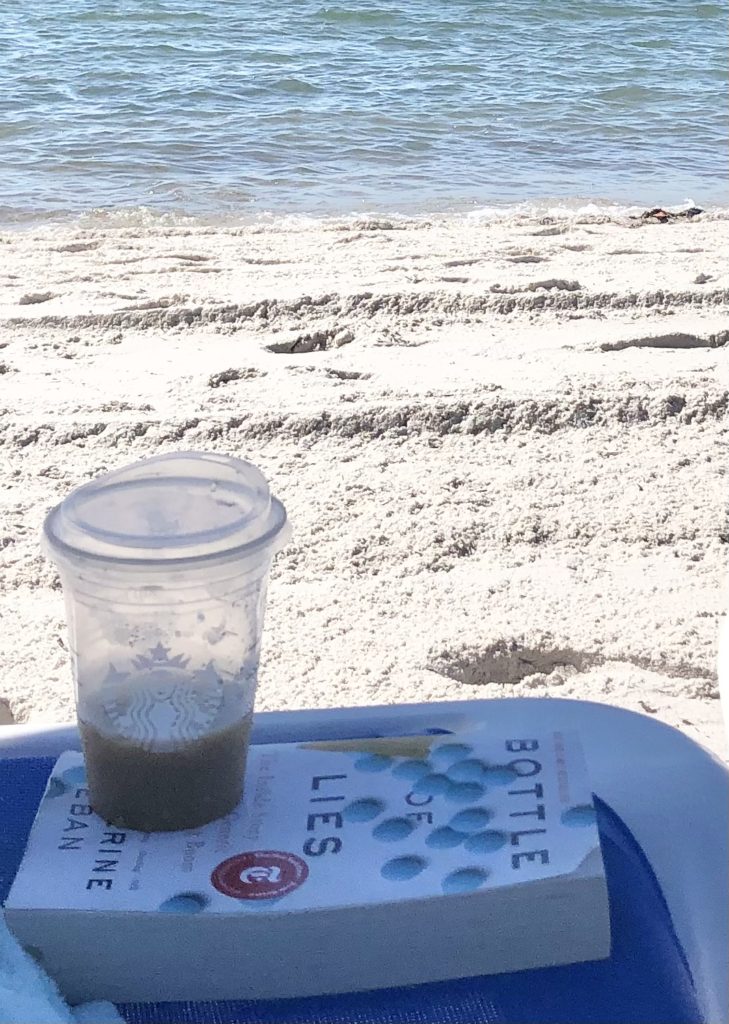
While on our most recent trip I started reading a New York Times Bestseller that had been on my reading list for a while, Bottle of Lies, The Inside Story of the Generic Drug Boom by Katherine Eban.  You GUYS! This book was intense and more than I expected.  The way Katherine investigated and wrote out the narrative is second to none.  I would recommend it to anyone working in healthcare (especially pharmacists!) and anyone working in healthcare legislation.   

Drug cost continues to be a hot topic of conversation and legislation.  The generic drug boom has been one of the most important public-health advances to aid in lowering drug costs.  We are taught that the FDA reviews an ANDA to ensure the generic has proven itself with bioequivalence studies. However, most of the generics are manufactured overseas which created a level of difficulty with conducting FDA inspections. This is the story of whistleblowers and regulators exposing fraud, falsified data and unsafe manufacturing practices that don’t meet the GMP standards.  It tells the challenges of the FDA to keep up with a boom of manufacturing plants across middle America, China, India, Africa and Brazil.  

It will leave you asking are the savings worth the risks.  What have we done in the interim to close off the loopholes that allowed subpar conditions and falsified data?  

I have gained an understanding for patients who feel concerned about trying a generic or distrust generics.  I think I will be able to better counsel patients who have concerns about having a poor reaction to a generic or reduced efficacy with a generic. I think generics have several benefits to our markets.  I plan to continue recommending generic drugs; however, I plan to be more empathetic and proactive to a patient who reports a concern with their generic. They can offer a more cost-effective product and reduce overall healthcare costs, which is desperately needed.

The ANDA Process

An ANDA (abbreviated new drug application) is submitted to the FDA for review and approval of a new generic product. The generic product must be comparable to the brand product in dose form, strength, route of administration, quality, bioavailability and indication for use. If the ANDA is acceptable and complete then the next steps include a bioavailability review, chemistry review, request for plant inspection, and labeling review. After approved, an applicant may manufacture and market the generic product. The application is considered abbreviated because the FDA does not typically require clinical testing to establish safety and efficacy since that was already established by the data the brand name drug submitted within their NDA (new drug application).

Equivalence and Substitution

Regulations fall within the jurisdiction of the individual states.

Pharmaceutical equivalence: same active ingredient, same dosage form, same route of administration, identical in dosage strength or concentration, may contain different excipients 

Therapeutic equivalence:  pharmaceutical equivalence and bioequivalent 

Bioequivalence | ADME

A = absorption

D = distribution

M = metabolism

E = elimination 

The manufacturer must submit graphs to the FDA illustrating the two products containing the same drug have similar blood concentration vs. time curves, including: 

Time to peak

Peak concentrations

Area under the curve (AUC)

References

Approved Drug Products with Therapeutic Equivalence Evaluations aka The Orange Book

The Electronic Orange Book (internet version)

United States Pharmacopeia Dispensing Information (USP/DI) Volume III plus supplements 

Facts and Comparisons, Inc Approved Bioequivalence Codes 

FDA’s Internet Website http://www.fda.gov

Drugs marketed before 1938 are not required to be in The Orange Book.

A Rated

Bioequivalent to the innovator’s drug product 

Therapeutically equivalent to the brand name or reference product

A-rated products may be substituted for one another.

B Rated

NOT bioequivalent to the innovator’s drug product 

B-rated products may not be substituted for one another.

Generally, a tablet cannot be substituted for a capsule, an ointment for a cream.  Most sustained-release or controlled-release are not interchangeable. 

AB Rated

Previously not considered to be bioequivalent and now organized into bioequivalence groups (AB1, AB2, AB3, etc)

Must have the same number or lack of number to be bioequivalent 

Cannot substitute an AB1 product for a product designated as AB2

The Federal government has not passed regulations limiting the substitution of these products although a few states have.

Examples:

Carbamazepine

Digoxin

Levothyroxine

Lithium

Phenytoin

Theophylline

Valproic acid

Warfarin

Checkout our self-guided courses and instant download study guides on Teachable for Texas, Iowa, Maryland and federal law!

Pharmacy – How Do We Fix Our Profession?

So, I had something else planned for the blog today.  With the recent coverage, I thought this would be an excellent time to bring up our profession.  

https://www.nbcnews.com/health/health-care/overworked-understaffed-pharmacists-say-industry-crisis-puts-patient-safety-risk-n1261151

As a whole.  

Where we are.  

Where we are headed.  

How we can fix our profession to best serve our patients and use our skills to the highest of our abilities.  

I have been in pharmacy for 10+ years and it has changed SIGNIFICANTLY during that period, not necessarily for the good of our profession or our patients.  

Some of us may work in areas that don’t feel impacted and I would encourage us to link together and support our colleagues who are struggling to take care of the patients they are devoted to in the way they wish they could.  I would encourage us to stand with our colleagues who can’t get away for a bathroom break, who don’t get a meal break, who aren’t allowed a stool to sit on, who aren’t able to take the time to counsel a patient who could benefit, who aren’t able to have a simple conversation with a recent widower who feels lonely to make them feel connected for the day, who are struggling to meet metrics that aren’t designed to serve our patients or other healthcare providers, who see the local Chik-Fil-A staffed better than their pharmacy, who feel like they are doing 5+ things at a time and struggling to do them well because of the constant interruptions.  We see you.

How can we improve this? How can we put healthcare and patients first again?  How can we better support other healthcare providers and the healthcare system as a whole? I don’t have the answers, but I think it’s time we start the discussion and continue it until we have some resolution. 

Thoughts.

Obtain provider status to be able to give patients access to and to allow us to bill for the valuable, expert care we are able to provide.

Provide medication therapy management through primary care, specialty services and/or local pharmacies.

Get involved in collaborative practice agreements in states that allow and work to expand in other states. Some ideas for collaborative practices:

            Anticoagulation

            Diabetes

            Hypertension

            Hyperlipidemia

            Pain Management

            Heart Failure

            Asthma/COPD

            Smoking Cessation

            Travel Vaccinations

Improved billing and financial margins for filling prescriptions.  Profit to pharmacies.

Adequate staffing to allow time for MTM, collaborative practice, vaccine clinics, and counseling.

Adequate staffing to handle the volume of incoming phone calls.

Adequate staffing to run a drive thru lane.

Adequate staffing or dedicated pharmacy hours that allow for meal breaks and bathroom breaks.

Time to connect to patients.

Time to follow up on patient specific inquiries and insurance issues to reduce or prevent escalations BEFORE they happen.  

Fair wages for support staff, technicians and pharmacists.

Incentives for continuing education, certifications, and participation in local, state and national pharmacy organizations to keep staff engaged and knowledgeable.

Recruit, train and hire leaders in pharmacy that are PHARMACISTS.  

Patient safety support and action from the state Boards of Pharmacy and pharmacy organizations.

Bye bye metrics.  Remove metrics. They don’t belong in healthcare.

“At the end of the day, at the end of the week, at the end of my life, I want to be able to say that I contributed more than I criticized.”

-Brene Brown