When taking the exam it’s important to read each question carefully and concentrate on which law, general concept or principle the question is testing.
When a drug name is given in the question identify if it is OTC, prescription only or a controlled substance. Use that information to determine which laws apply and how they apply to the question at hand.
Always remember, state law may be stricter and if so STATE LAW APPLIES.
How we can fix our profession to best serve our patients and use our skills to the highest of our abilities.
I have been in pharmacy for 10+ years and it has changed SIGNIFICANTLY during that period, not necessarily for the good of our profession or our patients.
Some of us may work in areas that don’t feel impacted and I would encourage us to link together and support our colleagues who are struggling to take care of the patients they are devoted to in the way they wish they could. I would encourage us to stand with our colleagues who can’t get away for a bathroom break, who don’t get a meal break, who aren’t allowed a stool to sit on, who aren’t able to take the time to counsel a patient who could benefit, who aren’t able to have a simple conversation with a recent widower who feels lonely to make them feel connected for the day, who are struggling to meet metrics that aren’t designed to serve our patients or other healthcare providers, who see the local Chik-Fil-A staffed better than their pharmacy, who feel like they are doing 5+ things at a time and struggling to do them well because of the constant interruptions. We see you.
How can we improve this? How can we put healthcare and patients first again? How can we better support other healthcare providers and the healthcare system as a whole? I don’t have the answers, but I think it’s time we start the discussion and continue it until we have some resolution.
Thoughts.
Obtain provider status to be able to give patients access to and to allow us to bill for the valuable, expert care we are able to provide.
Provide medication therapy management through primary care, specialty services and/or local pharmacies.
Get involved in collaborative practice agreements in states that allow and work to expand in other states. Some ideas for collaborative practices:
Anticoagulation
Diabetes
Hypertension
Hyperlipidemia
Pain Management
Heart Failure
Asthma/COPD
Smoking Cessation
Travel Vaccinations
Improved billing and financial margins for filling prescriptions. Profit to pharmacies.
Adequate staffing to allow time for MTM, collaborative practice, vaccine clinics, and counseling.
Adequate staffing to handle the volume of incoming phone calls.
Adequate staffing to run a drive thru lane.
Adequate staffing or dedicated pharmacy hours that allow for meal breaks and bathroom breaks.
Time to connect to patients.
Time to follow up on patient specific inquiries and insurance issues to reduce or prevent escalations BEFORE they happen.
Fair wages for support staff, technicians and pharmacists.
Incentives for continuing education, certifications, and participation in local, state and national pharmacy organizations to keep staff engaged and knowledgeable.
Recruit, train and hire leaders in pharmacy that are PHARMACISTS.
Patient safety support and action from the state Boards of Pharmacy and pharmacy organizations.
Bye bye metrics. Remove metrics. They don’t belong in healthcare.
“At the end of the day, at the end of the week, at the end of my life, I want to be able to say that I contributed more than I criticized.”
The test will not refer to specific laws by citation. Examples: Chapter 10.32.22, Regulations 10.34.22.01-.08 or Public Health Law Section 2164. Instead, focus on learning the law material and how to apply it.
Focus on well-established laws and regulations.
The test is not likely to ask or score questions related to recent changes in the law. The test is also not going to ask about temporary or recent exceptions such as the current COVID-19 exceptions in place.
When a drug name is given in the question identify if it is OTC, prescription only or a controlled substance.
Identify the regulations that may apply to the drug based on how it is classified and identify the general concept or principle the question is asking about. Think about the question in a straightforward manner. Questions are not written to trick.
Make sure to review how state and federal laws may differ in the particular state.
When there is a difference between federal and state laws and regulations, the strictest applies. Some specific areas to review and compare are controlled substance schedules, methamphetamine purchase limitations and regulations related to controlled substance prescriptions such as valid types of prescriptions, refill limitations, and expiration dates. Additionally, mid-level authority, technician ratios and authority, board licensing and renewals, collaborative practice agreements, immunizations, prescription monitoring programs, etc. vary from state to state.
Set aside a specific time to study.
It can be really easy to have good intentions of studying without ever making it happen. Plan and set aside time to study for the scheduled test date. Add it to a digital calendar or planner if needed. Once plans are in writing, it is easier to stick to those plans. Try to make sure your plans don’t interfere with work, family or other obligations. Have a regular study space that is comfortable and conducive to studying.
Don’t try to cram all at once.
It can be best to space studying out into more shorter sessions than one long binge session. If you are fighting heavy eyelids, it is really hard to study! Try not to procrastinate or find excuses not to study. There will always be other tasks to complete, material that is boring or difficult, however it’s important to stick to set study plans if at all possible. It can be best to plan for a 5-minute break every 30 to 40 minutes for longer study sessions. If possible, take a walk around the block, grab a snack or complete a short physical task during break periods.
Eliminate ALL the distractions.
It feels like there are SO many distractions these days. Technology can be a big one. Try to reduce notifications, background noises and access to mindless internet scrolling. Find a quiet place away from family or roommates if possible. Make sure to have good lighting, a comfortable temperature, and uncluttered workspace.
Organize notes or study material.
Group similar topics or information together. Break it up into sections. Look up and research any words or topics that aren’t understood to make sure notes are complete and accurate. Re-write or re-organize information if it’s presented in a way that doesn’t work well for your learning style. Color code, create charts, create tables or other graphics that help with learning if necessary. Or purchase a study guide or course that does this for you – that’s what we do!!
Organize material that needs to be studied. Have a goal of getting through a set number of sections, chapters or subject material.
Mark or highlight study material you will need to revisit.
If there is a topic that is particularly difficult, or the bulk of the test material, make sure to spend more time revisiting that material. Be able to find it easily and review it just prior to your test time.
I used to be intimidated at the thought of committing to career advancement. I felt overwhelmed by the options available. I didn’t know where to start, what interested me or where I should direct my time and energy. I was afraid of the potential time commitment and navigating the application processes.
I took my first steps into career advancement by signing up to obtain additional state pharmacist licenses. The process was easier and smoother than I had expected it to be. I thought it would be difficult to study and prepare while working full time and taking care of family commitments. I carved out time to study around our family commitments in the late evening, early morning and even during my kid’s activities (ALL the sports practices!).
There are so many options to consider! There are certificate programs, board specialties, licenses, and other educational opportunities. Any pharmacist can find their niche for career advancement. I recommend making sure any certification or specialization is being offered through a reputable organization. ASHP and APhA offer certificate programs. There are websites dedicated to the board specialties. Other educational opportunities may be found through online colleges or local colleges. I have included links below.
Certification Programs to consider:
Pain Management
Pediatrics
Diabetes Management
Medication Reconciliation
Pharmacy Revenue Cycle Management
Pharmacokinetics
Medication Safety
Emergency Medicine
Nutrition Support
Sterile Compounding
Sterile Product Preparation Institutional Training
Look for your dream job online, then review that position’s list of required and preferred qualifications, skills, abilities and requirements. This can be a great starting place to find out what you need to do to get where you want to be.
Lastly, I don’t want to downplay the power of networking. It can be VITAL, especially if you wish to find a position at a new company or in a different industry.
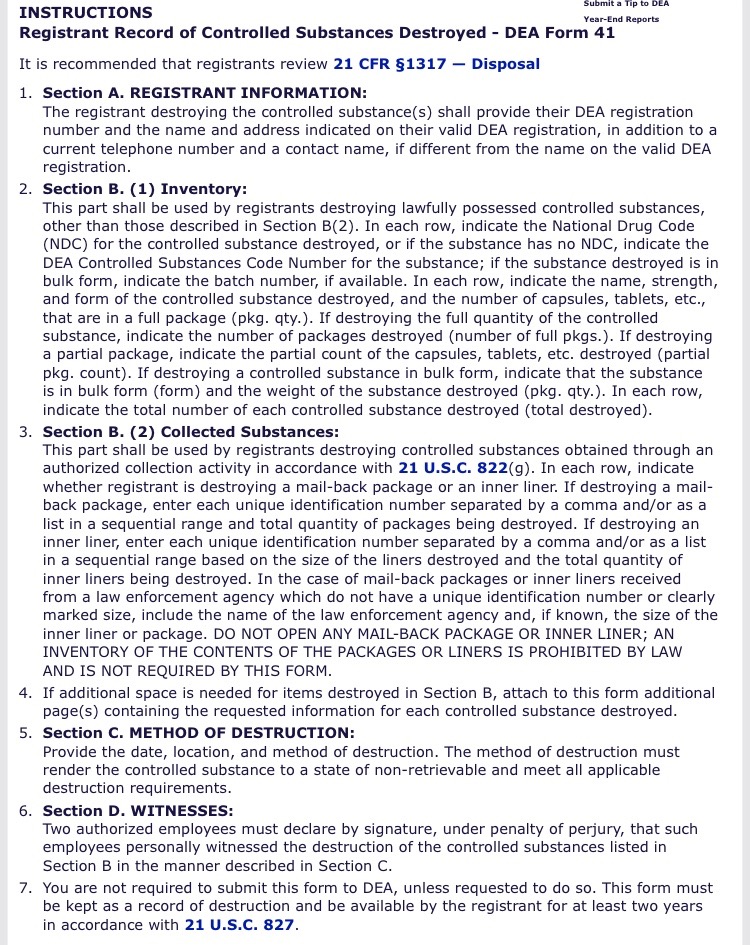
1. Request DEA authorization to destroy damaged, outdated, and/or unwanted controlled substances
Once per calendar year for retail pharmacies through the nearest DEA Division Field Office
Complete DEA Form 41 (Registrant’s Inventory of Drugs Surrendered)
Write a letter to the DEA to request permission to destroy, including: date and method of destruction, names of 2 people who will be witnesses (physician, pharmacist, physician assistant, nurse practitioner, nurse or law enforcement officer)
Send letter and DEA Form 41 at least 2 weeks prior to proposed destruction date and await written decision
Once destroyed, signed and completed copies of DEA Form 41 must be forwarded to the DEA
Exception to prior authorization: If a member of a state law enforcement authority or regulatory agency witnesses the destruction, then prior authorization from the nearest DEA Diversion Field Office or local DEA Special Agent in Charge is not required
Copies of a DEA Form 41 or state controlled substance destruction form must be forwarded to the local DEA Diversion Field Office after the destruction
2. Forward controlled substances to a DEA registered distributor who handles the disposal of drugs
Can be done at anytime
Local DEA Division Field Office can provide an updated list of distributors
The distributor must issue a DEA Form 222 to the pharmacy if CII medications are included
For CIII-CV, the pharmacy should document drug name, dose form, strength, quantity and date transferred in writing
The DEA registered distributor who will destroy the controlled substances is then responsible for submitting DEA Form 41 to the local DEA Diversion Office
Must keep records of dispensing, destruction, disposal including:
Patient name with date of birth or medical record number as second identifier
Drug name, dose and dose form
Prescriber
Name of individual that dispenses
Name of individual that administers
Date and time of administration
Name of witness observing disposal of unused drug
“Blanket Authorization”
Issued on a very limited basis for registrants associated with hospitals, clinics or others needing to dispose of used needles, syringes and other injectable objects only
Granted due to the contamination by hazardous body fluids
Requests for ”blanket authorization” are based on:
Frequency of destruction and volume involved
Method of destruction – must be incinerated or other method involving complete destruction
Registrant’s history
Security at the pharmacy or registered location
Name and title of the person responsible for destruction
An order may be partially filled within 60 days (expires at 60 days).
Purchaser notes the quantity recieved and date on Blue Copy 3 when receiving their order.
For Federal DEA purposes these records need to be kept for 2 years (some states may require longer).
Any unused forms must be returned to the DEA.
Lost or stolen forms should be reported to the Special Agent in Charge of the DEA in the Divisional office responsible for the area.
For reverse distributors, using the triplicate form process, pharmacy would receive Copy 1 and Copy 2 of the triplicate form, keeping Copy 1 and mailing Copy 2 to the local DEA office.
DEA Legal Amendment to Update to a Single-Sheet Format for DEA 222
SUMMARY: The Drug Enforcement Administration (DEA) is amending its regulations to implement a new single-sheet format for DEA Form 222, used by DEA registrants to order schedules I and II controlled substances. The rule provides for a two-year transition period, during which the existing triplicate version of the forms may continue to be used. The rule also includes a number of minor procedural changes.
Any triplicate forms on hand may be used until October 30, 2021.
Once triplicate forms on hand have been used, the DEA will begin sending single sheet DEA 222 Forms instead of the triplicate forms.
If any triplicate forms are still on hand on October 30, 2021, they should be sent into the Registration Section at DEA Headquarters and the single-sheet form should begin being used.
Since there is no longer a triplicate portion to keep at the pharmacy, the pharmacy will need to make a copy of the new single-sheet DEA 222 form either as a hard copy or electronic copy. Pharmacy will still need to document the quantity received and the date received at the pharmacy.
For Federal DEA purposes these records need to be kept for 2 years (some states may require longer).
The DEA 222 process has also been updated for reverse distributors. With the triplicate form process, pharmacy would receive Copy 1 and Copy 2 of the triplicate form, keeping Copy 1 and mailing Copy 2 to the local DEA office. With the single-sheet DEA 222 Form, pharmacy will receive the single copy, then make a copy and send it to the local DEA office. It is still required to document the quantity shipped and date shipped on the order form.
CSOS: Controlled Substance Ordering System
CSOS is the computerized system used for ordering controlled substances.
CSOS orders can include scheduled I-V and non-controlled.
If CSOS is down or the CSOS account is closed, then a paper form will be required to order.
Source: DEA website
1. An individual enrolls with DEA and, once approved, is issued a personal CSOS Certificate.
2. The purchaser creates an electronic 222 order using an approved ordering software. The order is digitally signed using the purchaser’s personal CSOS Certificate and then transmitted to the suppliers. The paper 222 is not required for electronic ordering.
3. The supplier receives the purchase order and verifies that the purchaser’s certificate is valid with DEA. Additionally, the supplier validates the electronic order information just like it would a paper order.
4. The supplier completes the order and ships to the purchaser. Any communications regarding the order are sent electronically.
5. The order is reported by the supplier to DEA within two business days
Above graphic and list is provided from the DEAecom.gov website.
Distribution shall be recorded by distributing and receiving pharmacies or practitioners. Receipts are to include: the controlled substance name, dosage form, dosage units in each container and number of containers ordered and received for record keeping.
If the controlled substance is a Schedule I or II, a DEA 222 must be used for the transaction.
Total number distributed during the calendar year shall not exceed 5% of the total number of all controlled substances during the same calendar year.
If number distributed will exceed 5% must obtain a registration to distribute controlled substances (i.e., wholesaler’s permit).
A PRESCRIBER MAY NOT WRITE A PRESCRIPTION FOR “OFFICE USE”.
All locations that manufacturer, distribute or dispense controlled substances must register with the DEA with the exception of:
Warehouses used for storage of controlled substance by registrants
A prescriber’s office where controlled substances are prescribed – not administered or dispensed.
Freight delivery companies
A location where sales of controlled substances are made, solicited or supervised, but the location does not actually keep controlled substances on site
DEA registrations are valid for 36 months.
Renewal forms are sent to the registrant 60 days before the current registration expires.
Registrant must contact the DEA in writing if they do not receive their renewal forms within 45 days before the current registration expires.
The DEA may deny or revoke a registration if:
Information on the application is untrue
Applicant has been convicted of a drug-related felony
Registration would be inconsistent with the public interest
State license has been suspended, revoked or denied
May also revoke license if applicant is excluded from Medicare or state health program participation
Federal law does NOT require the applicant for DEA registration to be a pharmacist.
Hospital registrations are treated as an “institutional practitioner” and DEA registration is issued to the entire hospital.
Power of Attorney
An applicant may authorize another individual or individuals to sign official forms by filing with the Registration Unit of the DEA, a Power of Attorney for each authorized individual. It remains valid until revoked with a Notice of Revocation.
ADULTERATED medications have an issue related to the COMPOSITION.
MISBRANDED medications have an issue with the LABELING.
Adulterated:
Contains any substance that is decomposing, filthy or putrid
Manufactured, packaged or stored in unsanitary conditions that may have caused contamination
Not manufactured under Good Manufacturing Practices (GMPs)
Contains a color additive that is unapproved
Contains a drug whose strength, purity or quality is lower than the official standards in the compendia
Contains a drug whose strength, purity or quality is lower than listed on the label
Container is made of a substance that leaches into the product
Contains any other ingredient as a substitute for the active drug listed
Misbranded:
Label has incorrect information or is misleading
Label does not list the name and location of the manufacturer, packer or distributor
Label does not contain a statement, word or any other information that is required by law
Label does not list the established name of the active drug
Label does not list each active drug ingredient
Label does not contain the “Rx Only” statement if the drug is only available by prescription (this is not required on the prescription label if dispensing to an outpatient consumer)
Label does not contain a precautionary statement for a medication that is at risk of deterioration
Label does not include the quantity of the container contents (such as count of 100, weight of 50g, or volume of 4 fl. oz.)
Non-prescription drug label does not contain adequate directions for use or appropriate warnings to protect consumers using the medication or packaging
Label is not in compliance with USP (US Pharmacopeia) and/or NF (National Formulary) specifications
Labeling offers one drug for sale under the name of a different drug
Pharmacy dispenses a prescription only medication without having a legal prescription or an authorized refill
Good Manufacturing Practices (GMPs)
Regulations that identify the minimum standards for manufacturing pharmaceuticals in the United States with the goal of safe and quality medications. Compliance is the responsibility of manufacturers. Manufacturers must be registered with the FDA, describe their manufacturing and production processes in their NDA (new drug application) process, and be inspected regularly. Inspections are typically every 2 years unless prior deficiencies warrant more frequent inspections.
Labeling
Labeling includes writing, print and/or graphics the immediate container of a medication and the outer container. If there is an outer container, labeling on the inner product must also appear on the outside container.
The package insert is considered part of the labeling.
The prescription label created by the pharmacist is also included in labeling.