Study Tips for the MPJE

Do not waste time memorizing law citations.

The test will not refer to specific laws by citation.  Examples: Chapter 10.32.22, Regulations 10.34.22.01-.08 or Public Health Law Section 2164.  Instead, focus on learning the law material and how to apply it. 

Focus on well-established laws and regulations.

The test is not likely to ask or score questions related to recent changes in the law. The test is also not going to ask about temporary or recent exceptions such as the current COVID-19 exceptions in place.  

When a drug name is given in the question identify if it is OTC, prescription only or a controlled substance.  

Identify the regulations that may apply to the drug based on how it is classified and identify the general concept or principle the question is asking about.  Think about the question in a straightforward manner. Questions are not written to trick.

Make sure to review how state and federal laws may differ in the particular state. 

When there is a difference between federal and state laws and regulations, the strictest applies.  Some specific areas to review and compare are controlled substance schedules, methamphetamine purchase limitations and regulations related to controlled substance prescriptions such as valid types of prescriptions, refill limitations, and expiration dates.  Additionally, mid-level authority, technician ratios and authority, board licensing and renewals, collaborative practice agreements, immunizations, prescription monitoring programs, etc. vary from state to state.

Set aside a specific time to study.

It can be really easy to have good intentions of studying without ever making it happen. Plan and set aside time to study for the scheduled test date.  Add it to a digital calendar or planner if needed.  Once plans are in writing, it is easier to stick to those plans.  Try to make sure your plans don’t interfere with work, family or other obligations.  Have a regular study space that is comfortable and conducive to studying. 

Don’t try to cram all at once.  

It can be best to space studying out into more shorter sessions than one long binge session.  If you are fighting heavy eyelids, it is really hard to study! Try not to procrastinate or find excuses not to study.  There will always be other tasks to complete, material that is boring or difficult, however it’s important to stick to set study plans if at all possible. It can be best to plan for a 5-minute break every 30 to 40 minutes for longer study sessions.  If possible, take a walk around the block, grab a snack or complete a short physical task during break periods.

Eliminate ALL the distractions.  

It feels like there are SO many distractions these days.  Technology can be a big one.  Try to reduce notifications, background noises and access to mindless internet scrolling.  Find a quiet place away from family or roommates if possible.  Make sure to have good lighting, a comfortable temperature, and uncluttered workspace.

Organize notes or study material.

Group similar topics or information together.  Break it up into sections.  Look up and research any words or topics that aren’t understood to make sure notes are complete and accurate.  Re-write or re-organize information if it’s presented in a way that doesn’t work well for your learning style.  Color code, create charts, create tables or other graphics that help with learning if necessary.  Or purchase a study guide or course that does this for you – that’s what we do!!

Create a specific goal for your study session.  

Organize material that needs to be studied.  Have a goal of getting through a set number of sections, chapters or subject material.    

Mark or highlight study material you will need to revisit.  

If there is a topic that is particularly difficult, or the bulk of the test material, make sure to spend more time revisiting that material.  Be able to find it easily and review it just prior to your test time.
What are grandfathered medications?

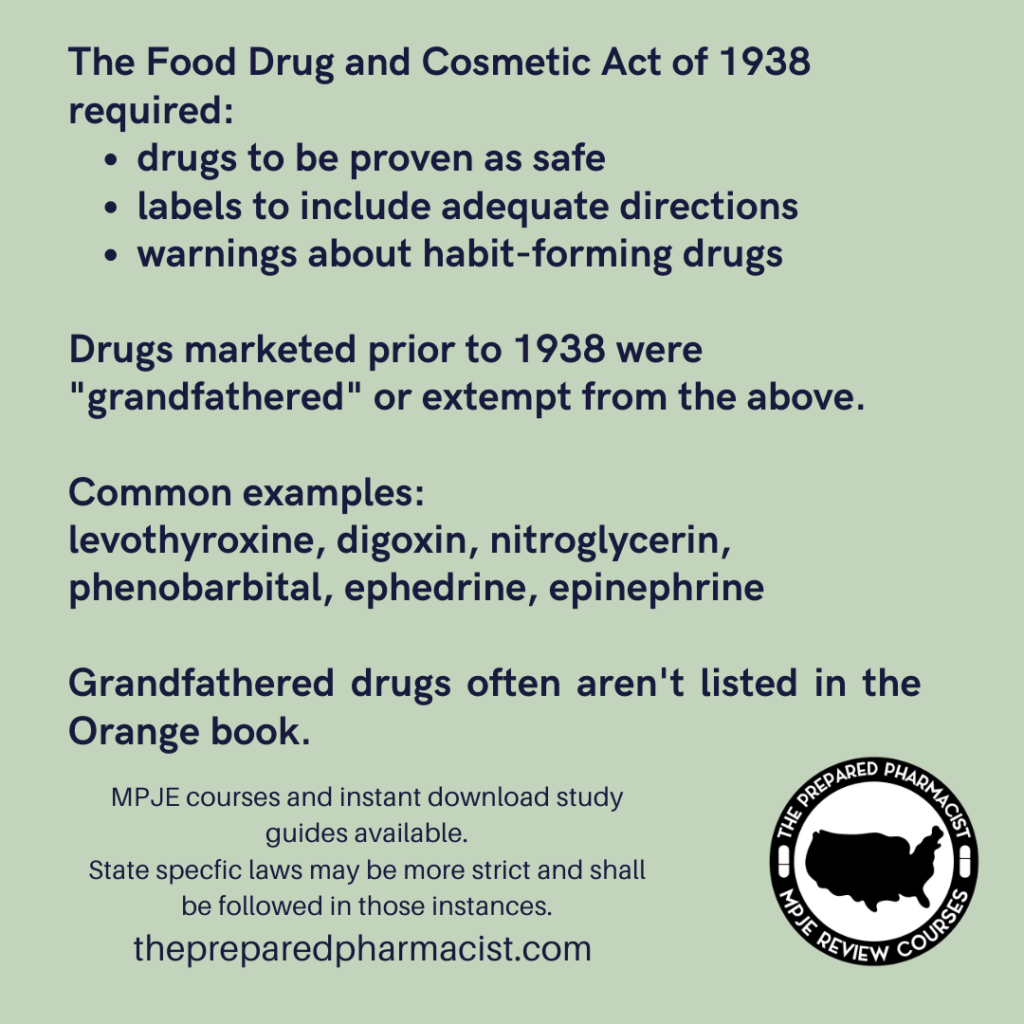
The Food Drug and Cosmetic Act of 1938

The Food Drug and Cosmetic Act of 1938 (FDCA) required medications be proven safe when used according to the directions on the label prior to marketing. It also required that labels include adequate directions for use. The Food Drug and Cosmetic Act of 1938 also requires habit-forming drugs to include a warning of the habit forming risk. Drugs already marketed prior to 1938 were exempt or “grandfathered” and did not require a change to their labeling or safety studies under this law. This was the first law that included cosmetics and medical devices into medication and food legislation. The FDCA also defined a dietary ingredient as “a vitamin, mineral, herb, or other botanical, amino acid, a dietary substance to supplement the diet by increasing the total dietary intake, or a concentrate, metabolite, constituent, extract, or combination of any of the aforementioned ingredients”. The FDCA also established the Homeopathic Pharmacopoeia of the United States (HPUS) as an official compendium, requiring drug products using an official listed name to meet all of its standards (otherwise would be considered misbranded or adulterated). This Act became the groundwork for further amendments and subsequent laws regarding drug legislation in the United States. Other specifications in the FDCA include the medications below.

Ipecac Syrup

Reminder: Ipecac Fluid Extract is not the same as Ipecac Syrup. Ipecac Fluid Extract is 14 times as potent as Ipecac Syrup!

Must have a statement boxed and in red text that states “For emergency use to cause vomiting in poisoning. Before using, call physician, the poison prevention center, or hospital emergency room immediately for advice.”

Must carry the statement “Warning: Keep out of reach of children. Do not use in unconcious persons or for poisoning involving corrosives (lye, strong acids), petroleum distillates such as kerosine, gasoline, cleaning fluids, or for strychnine”.

The usual dosage is 1 Tbsp or 15mL in patients over one year of age.

Ipecac syrup is only able to be sold in 1 oz or 30mL containers.

The FDCA also requires that certain drugs and adjuvants carry special warning labels. Examples are:

FD&C Yellow No. 5 (tartrazine)

Labeling must list in the precautions and specify that it may cause allergic reactions in some individuals

Aspartame

Labeling must carry a warning of “Phenylketonurics: Contains phenylalanine _x_ mg per _x_ (dosage unit)”

Sulfites

Labeling must contain an allergy warning in the labeling of prescription drugs and wines

Mineral Oil

Labeling must contain a warning that it should be used at bedtime, warn that it not be used in infants unless under the direction of a physician and should discourage use in pregnant women

Wintergreen oil (methyl salicylate) in amounts > 5%

Labeling should warn to keep out of the reach of children and also warn that using other than how directed may be dangerous

Sodium phosphate (saline laxative)

Packaging is limited to no more than 90mL per OTC container

Isoproterenol Inhalation Products

Labeling should warn not to exceed the dose prescribed and also warn to get medical assistance and/or contact physician if user continues to have breathing difficulty

Acetophenetidin (Phenacetin)

Labeling must carry a warning about possible kidney damage when taken in large amounts or for long periods of time

Salicylates (includes aspirin)

Labeling must include a warning about Reye’s Syndrome

Alcohol warning

Labeling for analgesics and antipyretics (acetaminophen, aspirin, ibuprofen, naproxen, etc.) are required to warn patients to consult with their physician before taking these medications if they consume ≥ 3 alcoholic beverages per day

The Poison Prevention Packaging Act

Today’s topic is child-resistant containers and closures.

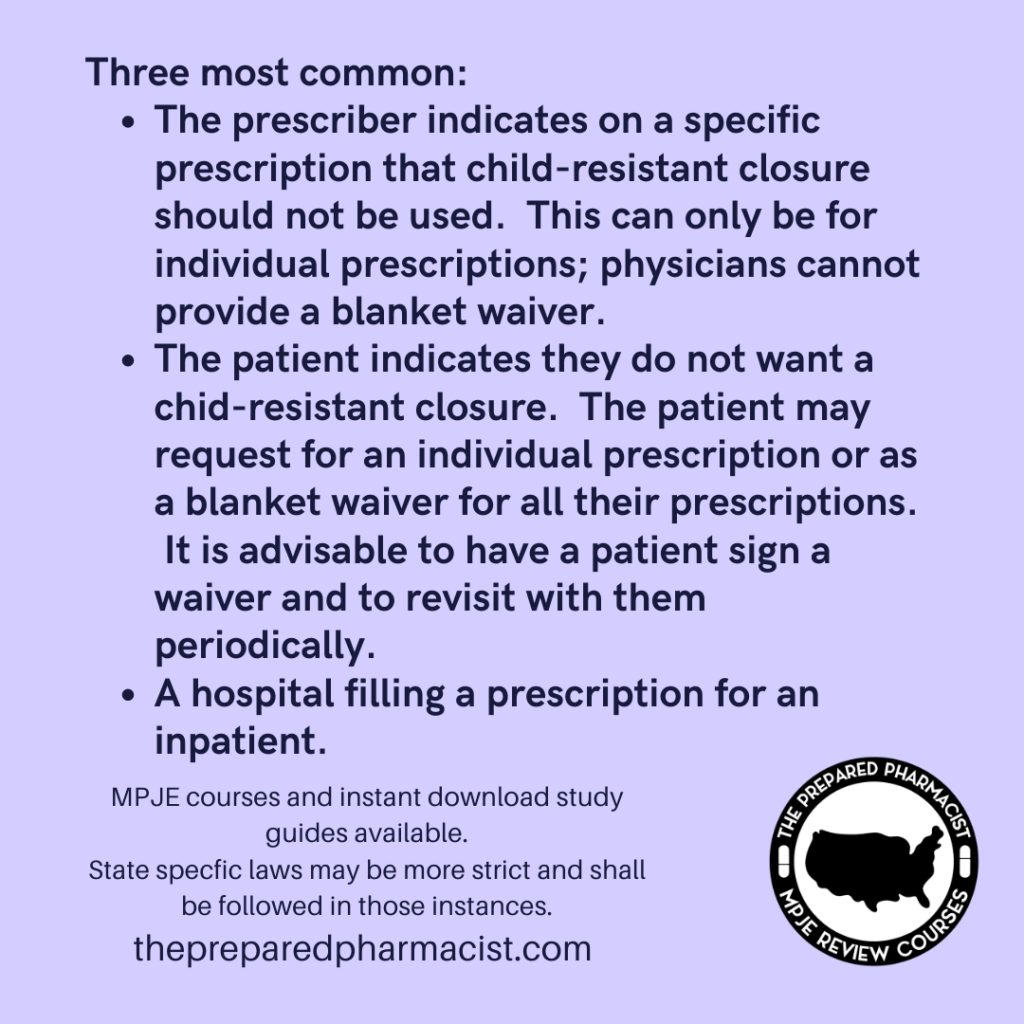
First take away is that physician’s CANNOT provide a blanket order.

Hospital inpatient prescriptions are not required to be child-resistant. Prescriptions filled by a hospital outpatient pharmacy ARE required to be in child-resistant packaging.

Customized patient medication packages (med paks) are not exempt from the Poison Prevention Packaging Act. They must be child-resistant, placed in an outer container that complies or patient must consent to non child-resistant packaging.

There are several medications that themselves are exempt from child-resistant packaging. A few examples are sublingual nitroglycerin, oral contraceptive packages and inhalers.