1. Request DEA authorization to destroy damaged, outdated, and/or unwanted controlled substances
Once per calendar year for retail pharmacies through the nearest DEA Division Field Office
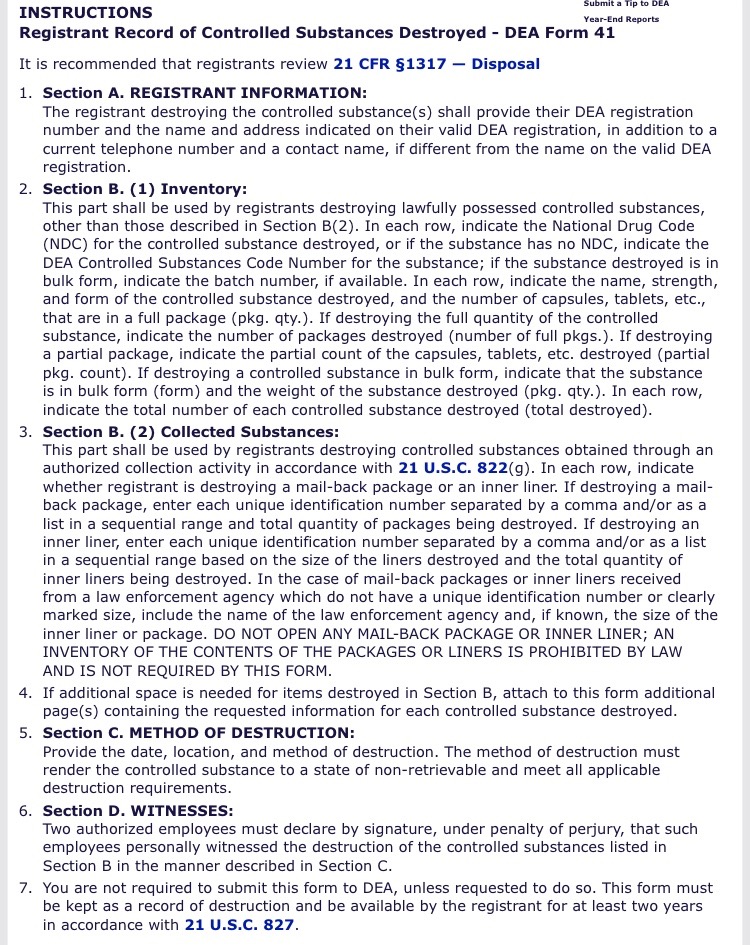
Complete DEA Form 41 (Registrant’s Inventory of Drugs Surrendered)
Write a letter to the DEA to request permission to destroy, including: date and method of destruction, names of 2 people who will be witnesses (physician, pharmacist, physician assistant, nurse practitioner, nurse or law enforcement officer)
Send letter and DEA Form 41 at least 2 weeks prior to proposed destruction date and await written decision
Once destroyed, signed and completed copies of DEA Form 41 must be forwarded to the DEA
Exception to prior authorization: If a member of a state law enforcement authority or regulatory agency witnesses the destruction, then prior authorization from the nearest DEA Diversion Field Office or local DEA Special Agent in Charge is not required
Copies of a DEA Form 41 or state controlled substance destruction form must be forwarded to the local DEA Diversion Field Office after the destruction
2. Forward controlled substances to a DEA registered distributor who handles the disposal of drugs
Can be done at anytime
Local DEA Division Field Office can provide an updated list of distributors
The distributor must issue a DEA Form 222 to the pharmacy if CII medications are included
For CIII-CV, the pharmacy should document drug name, dose form, strength, quantity and date transferred in writing
The DEA registered distributor who will destroy the controlled substances is then responsible for submitting DEA Form 41 to the local DEA Diversion Office
Must keep records of dispensing, destruction, disposal including:
Patient name with date of birth or medical record number as second identifier
Drug name, dose and dose form
Prescriber
Name of individual that dispenses
Name of individual that administers
Date and time of administration
Name of witness observing disposal of unused drug
“Blanket Authorization”
Issued on a very limited basis for registrants associated with hospitals, clinics or others needing to dispose of used needles, syringes and other injectable objects only
Granted due to the contamination by hazardous body fluids
Requests for ”blanket authorization” are based on:
Frequency of destruction and volume involved
Method of destruction – must be incinerated or other method involving complete destruction
Registrant’s history
Security at the pharmacy or registered location
Name and title of the person responsible for destruction
An order may be partially filled within 60 days (expires at 60 days).
Purchaser notes the quantity recieved and date on Blue Copy 3 when receiving their order.
For Federal DEA purposes these records need to be kept for 2 years (some states may require longer).
Any unused forms must be returned to the DEA.
Lost or stolen forms should be reported to the Special Agent in Charge of the DEA in the Divisional office responsible for the area.
For reverse distributors, using the triplicate form process, pharmacy would receive Copy 1 and Copy 2 of the triplicate form, keeping Copy 1 and mailing Copy 2 to the local DEA office.
DEA Legal Amendment to Update to a Single-Sheet Format for DEA 222
SUMMARY: The Drug Enforcement Administration (DEA) is amending its regulations to implement a new single-sheet format for DEA Form 222, used by DEA registrants to order schedules I and II controlled substances. The rule provides for a two-year transition period, during which the existing triplicate version of the forms may continue to be used. The rule also includes a number of minor procedural changes.
Any triplicate forms on hand may be used until October 30, 2021.
Once triplicate forms on hand have been used, the DEA will begin sending single sheet DEA 222 Forms instead of the triplicate forms.
If any triplicate forms are still on hand on October 30, 2021, they should be sent into the Registration Section at DEA Headquarters and the single-sheet form should begin being used.
Since there is no longer a triplicate portion to keep at the pharmacy, the pharmacy will need to make a copy of the new single-sheet DEA 222 form either as a hard copy or electronic copy. Pharmacy will still need to document the quantity received and the date received at the pharmacy.
For Federal DEA purposes these records need to be kept for 2 years (some states may require longer).
The DEA 222 process has also been updated for reverse distributors. With the triplicate form process, pharmacy would receive Copy 1 and Copy 2 of the triplicate form, keeping Copy 1 and mailing Copy 2 to the local DEA office. With the single-sheet DEA 222 Form, pharmacy will receive the single copy, then make a copy and send it to the local DEA office. It is still required to document the quantity shipped and date shipped on the order form.
CSOS: Controlled Substance Ordering System
CSOS is the computerized system used for ordering controlled substances.
CSOS orders can include scheduled I-V and non-controlled.
If CSOS is down or the CSOS account is closed, then a paper form will be required to order.
Source: DEA website
1. An individual enrolls with DEA and, once approved, is issued a personal CSOS Certificate.
2. The purchaser creates an electronic 222 order using an approved ordering software. The order is digitally signed using the purchaser’s personal CSOS Certificate and then transmitted to the suppliers. The paper 222 is not required for electronic ordering.
3. The supplier receives the purchase order and verifies that the purchaser’s certificate is valid with DEA. Additionally, the supplier validates the electronic order information just like it would a paper order.
4. The supplier completes the order and ships to the purchaser. Any communications regarding the order are sent electronically.
5. The order is reported by the supplier to DEA within two business days
Above graphic and list is provided from the DEAecom.gov website.
Distribution shall be recorded by distributing and receiving pharmacies or practitioners. Receipts are to include: the controlled substance name, dosage form, dosage units in each container and number of containers ordered and received for record keeping.
If the controlled substance is a Schedule I or II, a DEA 222 must be used for the transaction.
Total number distributed during the calendar year shall not exceed 5% of the total number of all controlled substances during the same calendar year.
If number distributed will exceed 5% must obtain a registration to distribute controlled substances (i.e., wholesaler’s permit).
A PRESCRIBER MAY NOT WRITE A PRESCRIPTION FOR “OFFICE USE”.
All locations that manufacturer, distribute or dispense controlled substances must register with the DEA with the exception of:
Warehouses used for storage of controlled substance by registrants
A prescriber’s office where controlled substances are prescribed – not administered or dispensed.
Freight delivery companies
A location where sales of controlled substances are made, solicited or supervised, but the location does not actually keep controlled substances on site
DEA registrations are valid for 36 months.
Renewal forms are sent to the registrant 60 days before the current registration expires.
Registrant must contact the DEA in writing if they do not receive their renewal forms within 45 days before the current registration expires.
The DEA may deny or revoke a registration if:
Information on the application is untrue
Applicant has been convicted of a drug-related felony
Registration would be inconsistent with the public interest
State license has been suspended, revoked or denied
May also revoke license if applicant is excluded from Medicare or state health program participation
Federal law does NOT require the applicant for DEA registration to be a pharmacist.
Hospital registrations are treated as an “institutional practitioner” and DEA registration is issued to the entire hospital.
Power of Attorney
An applicant may authorize another individual or individuals to sign official forms by filing with the Registration Unit of the DEA, a Power of Attorney for each authorized individual. It remains valid until revoked with a Notice of Revocation.
ADULTERATED medications have an issue related to the COMPOSITION.
MISBRANDED medications have an issue with the LABELING.
Adulterated:
Contains any substance that is decomposing, filthy or putrid
Manufactured, packaged or stored in unsanitary conditions that may have caused contamination
Not manufactured under Good Manufacturing Practices (GMPs)
Contains a color additive that is unapproved
Contains a drug whose strength, purity or quality is lower than the official standards in the compendia
Contains a drug whose strength, purity or quality is lower than listed on the label
Container is made of a substance that leaches into the product
Contains any other ingredient as a substitute for the active drug listed
Misbranded:
Label has incorrect information or is misleading
Label does not list the name and location of the manufacturer, packer or distributor
Label does not contain a statement, word or any other information that is required by law
Label does not list the established name of the active drug
Label does not list each active drug ingredient
Label does not contain the “Rx Only” statement if the drug is only available by prescription (this is not required on the prescription label if dispensing to an outpatient consumer)
Label does not contain a precautionary statement for a medication that is at risk of deterioration
Label does not include the quantity of the container contents (such as count of 100, weight of 50g, or volume of 4 fl. oz.)
Non-prescription drug label does not contain adequate directions for use or appropriate warnings to protect consumers using the medication or packaging
Label is not in compliance with USP (US Pharmacopeia) and/or NF (National Formulary) specifications
Labeling offers one drug for sale under the name of a different drug
Pharmacy dispenses a prescription only medication without having a legal prescription or an authorized refill
Good Manufacturing Practices (GMPs)
Regulations that identify the minimum standards for manufacturing pharmaceuticals in the United States with the goal of safe and quality medications. Compliance is the responsibility of manufacturers. Manufacturers must be registered with the FDA, describe their manufacturing and production processes in their NDA (new drug application) process, and be inspected regularly. Inspections are typically every 2 years unless prior deficiencies warrant more frequent inspections.
Labeling
Labeling includes writing, print and/or graphics the immediate container of a medication and the outer container. If there is an outer container, labeling on the inner product must also appear on the outside container.
The package insert is considered part of the labeling.
The prescription label created by the pharmacist is also included in labeling.