Equivalence and Substitution

Regulations fall within the jurisdiction of the individual states.

Pharmaceutical equivalence: same active ingredient, same dosage form, same route of administration, identical in dosage strength or concentration, may contain different excipients 

Therapeutic equivalence:  pharmaceutical equivalence and bioequivalent 

Bioequivalence | ADME

A = absorption

D = distribution

M = metabolism

E = elimination 

The manufacturer must submit graphs to the FDA illustrating the two products containing the same drug have similar blood concentration vs. time curves, including: 

Time to peak

Peak concentrations

Area under the curve (AUC)

References

Approved Drug Products with Therapeutic Equivalence Evaluations aka The Orange Book

The Electronic Orange Book (internet version)

United States Pharmacopeia Dispensing Information (USP/DI) Volume III plus supplements 

Facts and Comparisons, Inc Approved Bioequivalence Codes 

FDA’s Internet Website http://www.fda.gov

Drugs marketed before 1938 are not required to be in The Orange Book.

A Rated

Bioequivalent to the innovator’s drug product 

Therapeutically equivalent to the brand name or reference product

A-rated products may be substituted for one another.

B Rated

NOT bioequivalent to the innovator’s drug product 

B-rated products may not be substituted for one another.

Generally, a tablet cannot be substituted for a capsule, an ointment for a cream.  Most sustained-release or controlled-release are not interchangeable. 

AB Rated

Previously not considered to be bioequivalent and now organized into bioequivalence groups (AB1, AB2, AB3, etc)

Must have the same number or lack of number to be bioequivalent 

Cannot substitute an AB1 product for a product designated as AB2

The Federal government has not passed regulations limiting the substitution of these products although a few states have.

Examples:

Carbamazepine

Digoxin

Levothyroxine

Lithium

Phenytoin

Theophylline

Valproic acid

Warfarin

Checkout our self-guided courses and instant download study guides on Teachable for Texas, Iowa, Maryland and federal law!

Other Pharmacist Roles: Non-dispensing and/or Work from Home Roles

Many of us desire to use our top-notch expertise as a medication expert to help others in a way that is profitable and flexible.  The world outside of work continues to demand more and more of us.  There’s a big buzz about creating work/life balance.  Work/life balance is having equilibrium where an individual feels they are equally prioritizing the demands of their career responsibilities and of their personal life. More and more companies are in the news offering flexible work hours, the ability to telecommute or work from home, unlimited PTO, paid maternity and paternity leave, in addition to other millennial worker requests such as competitive compensation, comfortable offices, opportunities for growth and advancement and social connections. Pharmacy doesn’t seem to be as progressive in these enhancements or modifications as other industries.

However, there are pharmacy career options that offer remote work, part-time work and/or flexible scheduling. Adding more time into the day by eliminating a commute to and from work can be life-changing. Being able to reduce hours or set your own hours can allow time for personal activities and responsibilities. These careers can be difficult to find and it can be hard to get an initial interview when an opening is available.  Some may require brave steps of making your own company or creating your own career.  Others may require you to continue your primary job while you begin your own side hustle start-up with hopes of it generating enough income that you can then cut back from your primary job.  

Medication Therapy Management

Prescription Approval and/or Remote Order Entry

Prior Authorization Review

Drug Information

Quality Improvement

Medical writing and/or Reviewing Medical Literature

Create your own – Consulting, Pharmacogenetics, Coaching, Entrepreneurship 

How do I find one of these positions?

Check out job board websites like Indeed, LinkedIn, SimplyHired and LinkUp.  Download their apps and then create alerts to notify you when there is a posting that may match your ideal position.  Find out what companies are hiring for positions of interest and create alerts to notify you when those companies post a new position.  Review the qualifications, requirements, licenses, certifications and skills the employer is looking for and gain experience and skills in those areas.  

Hire a professional to review your resume and cover letter.  A candidate with experience and skills but a poor resume may not even be asked to interview.  An impressive resume and cover letter are essential!  There are individuals and companies that specialize in resume templates, reviews and custom writing for pharmacists. If you think yours could use some improvement check out these services. A simple google search of pharmacist resume service will bring up options. I would recommend using a service dedicated to pharmacists or healthcare professionals.

Network. Network. Network.  Network virtually and in person.  Places to consider are LinkedIn, local, state and national pharmacist organizations and Facebook groups of interest.  A resume and profile can be created and kept up to date on LinkedIn listing experience, education, licenses, certificates, skills and accomplishments.  State pharmacist organizations can be a great way to get to know other pharmacists and companies in your region.  Many niche pharmacy groups have larger national organizations with committees, meetings, continuing education programs and more opportunities to get involved with pharmacists working in your area of interest all over the country.  If you can, volunteer to service on a committee or help with a project. There are Facebook groups for several pharmacist and pharmacy areas of interest.  Try searching a topic of interest such as MTM, consulting, etc. and pharmacist.  Join any groups that seem interesting or relevant to your pursuits.  There is much that can be learned from these groups and it creates a community for discussion, posting jobs, and collaboration.

Be brave, be vulnerable. Try new things, meet new people and put yourself out there.   

Check out our self-guided course and instant download study guides. on Teachable for Texas MPJE, Iowa MPJE, Maryland MPJE and Federal Law Review!

Drug Approval Process

My tests had several questions that referenced to the drug approval process. I suggest that anyone planning to take the MPJE for any state be familiar with the drug approval processes

Investigational New Drug Application

•1stapplication before drug is given to humans

•Federal Drug Administration (FDA) has 30 days to decide if suitable for testing

•Must provide clinical protocols to be used in human testing

Clinical Trials

Initiated after FDA approves the investigational new drug application

3 phases before marketing and 1 phase after marketing

Phase 1: Small group of healthy individuals to evaluate toxicity, kinetics, safety

Phase 2: Large group (100+) with the disease being treated to evaluate effectiveness, safety, and adverse drug events (ADEs)

Phase 3: Large group (1000+) to evaluate effectiveness, double-blinded with placebo

Phase 4: Post-marketing surveillance to determine if drug should stay on the market

New Drug Application (NDA)

Can apply once data on safety, efficacy, toxicity, stability, production methods, packaging and clinical trial data exists

Typically takes 6 months for review 

Abbreviated New Drug Application (ANDA)

For introducing a generic of an already approved drug

Requires proof of kinetics, bioequivalence/bioavailability

Supplemental New Drug Application (SNDA)

For changes to synthesis, production, manufacturer location, packaging and/or labeling

For new dose form, strength or therapeutic use

Epidiolex – What is it? Is it a controlled substance?

What is it?

First and only FDA-approved prescription cannabidiol (CBD)

What is it used for?

Seizures associated with Lennox-Gastaut syndrome (LGS), Dravet syndrome or tuberous sclerosis complex (TSC)

Mechanism of action for the reduction of seizures is unknown.

How is it dosed and taken?

Titrated dosing given orally or via feeding tube (non PVC) twice daily, administered consistently with or without food.

LGS or Dravet syndrome:

Initial dose: 5mg/kg/day (2.5mg/kg twice daily)

Recommended dosing: 10 to 15mg/kg/day (5 to 7.5mg/kg twice daily) increased in weekly increments of 5mg/kg/day (2.5mg/kg twice daily)

Maximum dosing: 20mg/kg/day (10mg/kg twice daily) 

TSC:

Initial dose: 5mg/kg/day (2.5mg/kg twice daily)

Recommended dosing: 10 to 20mg/kg/day (5 to 10mg/kg twice daily) increased in weekly increments of 5mg/kg/day (2.5mg/kg twice daily)

Maximum dosing: 25mg/kg/day (12.5mg/kg twice daily) 

If rapid titration is necessary, dose may be increased no more frequently than every other day.
Dose adjustment and a slower titration is recommended in patients with moderate to severe hepatic impairment.
Should not be stopped suddenly due to the risk of increased frequency of seizures and status epilepticus. 

Recommended lab work: 

Transaminase and bilirubin levels prior to starting treatment, at month 1, month 3 and month 6 then periodically thereafter.

Patients on valproate or are at increased risk of elevated transaminase levels and/or hepatocellular injury.  

If levels are elevated, consider a dose reduction or discontinuation of Epidiolex or other medications known to increase transaminase levels such as valproate and/or clobazam.  

Common side effects (> 10% and greater than placebo): transaminase elevations, somnolence, fatigue, malaise, asthenia, decreased appetite, diarrhea, vomiting, pyrexia, rash, insomnia and infections.

Other important side effects to be aware of: suicidal behavior and ideation

Potential interactions to consider:

Several potential drug-drug interactions to consider, most commonly run into potential drug-drug interactions with other anticonvulsant medications:

Clobazam, diazepam, & valproate

Recommended to counsel patient or caregiver on signs/symptoms to watch for and recommend lab work as appropriate.  

Strawberry flavored but does not contain strawberry.

Compatible with a ketogenic diet.

Federal law no longer considers Epidiolex to be a controlled substance.  It had originally been federally scheduled as a CV.  Now it is federally non-controlled.  There are a handful of states that have it scheduled as a controlled substance.  

https://www.drugtopics.com/view/dea-deschedules-antiepileptic-cbd-oral-solution-epidiolex

Controlled StatusState
CIVLouisiana
CVFlorida
CVGeorgia
CVIdaho
CVMaryland
CVMontana
CVNebraska
CVNorth Dakota
CVPuerto Rico
Controlled Substance Status of Epidiolex (all other states are non-controlled)

Other State Specific Controlled Substance Topics

It’s a great idea to consider some other state specific controlled substance regulations.  Some of these may be:

State Controlled Substance Monitoring Program

Not all states, however most states have a controlled substance monitoring program that allows prescribers and pharmacists to evaluate a patient’s prescription drug history.  Each state can specify what information is reportable, how soon after dispensing it must be reported, how it is reviewed and documented, which medications are included, specific exemptions and how long records must be kept.  Some states also require a zero report be filed even if a pharmacy does not dispense controlled substances.

State Specific Controlled Substances

Some states designate a medication as a controlled substance or a stricter class of controlled substance even if federal law does not.  Some examples of medications to look at for this are: growth hormone, HCG, testosterone, Epidiolex (cannabidiol), Neurontin (gabapentin), Ultam (tramadol), butalbital containing products, Donnatol (phenobarbital and belladonna alkaloids), Librax (chlordiazepoxide and clinidium), ephedrine, pseudoephedrine, Soma (carisoprodol), etc.

Mid-Level Practitioners Prescribing Authority

Prescriber authority for mid-level practitioners such as nurse practitioners or physician assistants can vary state to state.  Some are limited as to what controls they may prescribe, day supply allowed, what setting they may prescribe in, etc. The button below is a link to the DEA website that provides a listing by state.

Naloxone

Some states allow pharmacists to dispense Naloxone without a prescription under a collaborative practice agreement, statewide protocol or standing order.  There are different limitations and documentation required state to state.

Controlled Substances CIII-CV

When taking the exam it’s important to read each question carefully and concentrate on which law, general concept or principle the question is testing.

When a drug name is given in a question, identify if it is OTC, prescription only or a controlled substance. Then, use that information to determine which laws apply and how they apply to the question at hand.

Always remember, state law may be stricter and if so STATE LAW APPLIES.

CIII Medications

Drugs with Moderate to Low Potential for Physical and Psychological Dependence

Combination products containing less than 90mg of codeine per dosage unit (Tylenol with codeine)

Fiorinal is CIII however Fioricet is non-controlled

  Fiorinal: ASA 325mg/butalbital 50mg/caffeine 40mg

  Fioricet: APAP 325mg/butalbital 50mg/caffeine 40mg

buprenorphine (Suboxone)benzphetamine (Didrex)
ketaminephendimetrazine
anabolic steroidsThiopental
testosteroneFiorinal
CIII medications

CIV Medications

Drugs with Low Potential for Abuse or Dependence
alprazolam (Xanax)diazepam (Valium)
carisoprodol (Soma)lorazepam (Ativan)
clonazepam (Klonopin)midazolam (Versed)
clorazepate (Tranxene)temazepam (Restoril)
triazolam (Halcion)phenobarbital
butorphanol
CIV Medications

CV Medications

Drugs with Lower Potential for Abuse 

Preparations containing limited quantities of certain narcotics

Generally used for antidiarrheals, antitussives, and analgesic purposes

Examples: Cough preparations with ≤ 200mg of codeine per 100mL or 100g (Robitussin AC, Phenergan with Codeine), Lomotil, Lyrica

CIII-CV Valid Types of Prescriptions

Written signed prescription

Fax of written prescription

Erx

Verbal

Containing all information except prescriber signature

Transfer

ONE TIME for the purpose of REFILL dispensing

Pharmacies electronically sharing a real-time system may transfer up to max refills permitted by law and prescription

CIII-CIV Refills (and CV in Most States)

No more than 5 refills within a 6 month period

Must keep information on the back of the original prescription or in a computerized record-keeping system

Must be accessible within 48 hours

Must record: Prescriber name, Name and address of the patient, Quantity dispensed on each refill, Date of dispensing for each refill, Name or ID code of the dispensing pharmacist and Number of the original prescription order

CIII-CV Partial Filling

Partial filling is allowed

Each partial should be recorded in the same manner as a refill

The total quantity dispensed in all partial fillings cannot exceed the total quantity prescribed

No dispensing may occur beyond 6 months after the date Rx was written

Filling a CV Without a Prescription/Limitations

Only a pharmacist may dispense an over the counter CV

A non-pharmacist may complete the money transfer at the register

Purchaser must be ≥ 18 years old (Rph can require proof of age)

Furnish identification 

Bound record book must be maintained by the pharmacist: Name and address of the purchaser, Name and quantity of the CV purchased, Date of purchase, Name or initials of pharmacist that dispensed, Records must be kept for 2 years

Not more than _______ in a 48 hourperiod to the same purchaser

240mL (8 ounces) of any controlled substance containing opium

48 dosage units of any such controlled substance containing opium

120mL (4 ounces) of any other controlled substance

24 dosage units of any other controlled substance

Therefore, MAX is 4 fluid ounces of codeine containing cough syrup over the counter to a given purchaser in a 48 hour period.

Check out the detailed information in our guided course and downloadable study guides on Teachable.

Controlled Substances CII

When taking the exam it’s important to read each question carefully and concentrate on which law, general concept or principle the question is testing.  

When a drug name is given in the question identify if it is OTC, prescription only or a controlled substance. Use that information to determine which laws apply and how they apply to the question at hand.

Always remember, state law may be stricter and if so STATE LAW APPLIES.

Drugs with a high potential for abuse
Potential to lead to severe psychological or physical dependence
Dangerous
hydromorphone (Dilaudid) fentanyl (Sublimaze, Duragesic)hydrocodoneamobarbital
methadone (Dolophine)morphineamphetamine (Dexedrine, Adderall)glutethimide
meperidine (Demerol)opiummethamphetamine (Desoxyn)pentobarbital 
oxycodone (OxyContin, Percocetcodeinemethylphenidate (Ritalin)secobarbital
CII Controlled Substances

Barbiturates

Amobarbital (Amytal), pentobarbital (Nembutal) and secobarbital (Seconal) are CIIs.

Phenobarbital (Luminal) is a CIV.

Hydrocodone

Hydrocodone was reclassified to CII in 2014.

CII Prescription Requirements: Valid Types of Prescriptions

Written signed prescription

Erx

Oral (ONLY in emergency)

Fax (ONLY if home infusion, long term care facility, hospice)

CII Prescriptions: What Can be Changed?

Patient address (can also obtain from patient)

Drug strength

Dosage form

Drug quantity

Directions

CII Prescriptions: What Cannot be Changed?

Patient’s Name

Controlled substance prescribed

Prescriber’s Signature

⬆️ Any of the above items would require a new prescription.

CII Prescriptions: Partial Filling

No refills are allowed on CII prescriptions

Partial may be dispensed: 

*If it is not prohibited by State laws*

The partial fill is requested by the patient or the practitioner who wrote the prescription.

The total quantity dispensed in all partial fillings does not exceed the total quantity prescribed.

Within 30 days of the date on which the prescription was written 

Exception: Terminal patients may get a partial dispense and prescription is void 60 days after written

Partial dispense prescription documentation:

Date of partial fill

Quantity dispensed

Remaining quantity

Dispensing pharmacist

Check out the detailed information in our guided course and downloadable study guides on Teachable!!

Study Tips for the MPJE

Do not waste time memorizing law citations.

The test will not refer to specific laws by citation.  Examples: Chapter 10.32.22, Regulations 10.34.22.01-.08 or Public Health Law Section 2164.  Instead, focus on learning the law material and how to apply it. 

Focus on well-established laws and regulations.

The test is not likely to ask or score questions related to recent changes in the law. The test is also not going to ask about temporary or recent exceptions such as the current COVID-19 exceptions in place.  

When a drug name is given in the question identify if it is OTC, prescription only or a controlled substance.  

Identify the regulations that may apply to the drug based on how it is classified and identify the general concept or principle the question is asking about.  Think about the question in a straightforward manner. Questions are not written to trick.

Make sure to review how state and federal laws may differ in the particular state. 

When there is a difference between federal and state laws and regulations, the strictest applies.  Some specific areas to review and compare are controlled substance schedules, methamphetamine purchase limitations and regulations related to controlled substance prescriptions such as valid types of prescriptions, refill limitations, and expiration dates.  Additionally, mid-level authority, technician ratios and authority, board licensing and renewals, collaborative practice agreements, immunizations, prescription monitoring programs, etc. vary from state to state.

Set aside a specific time to study.

It can be really easy to have good intentions of studying without ever making it happen. Plan and set aside time to study for the scheduled test date.  Add it to a digital calendar or planner if needed.  Once plans are in writing, it is easier to stick to those plans.  Try to make sure your plans don’t interfere with work, family or other obligations.  Have a regular study space that is comfortable and conducive to studying. 

Don’t try to cram all at once.  

It can be best to space studying out into more shorter sessions than one long binge session.  If you are fighting heavy eyelids, it is really hard to study! Try not to procrastinate or find excuses not to study.  There will always be other tasks to complete, material that is boring or difficult, however it’s important to stick to set study plans if at all possible. It can be best to plan for a 5-minute break every 30 to 40 minutes for longer study sessions.  If possible, take a walk around the block, grab a snack or complete a short physical task during break periods.

Eliminate ALL the distractions.  

It feels like there are SO many distractions these days.  Technology can be a big one.  Try to reduce notifications, background noises and access to mindless internet scrolling.  Find a quiet place away from family or roommates if possible.  Make sure to have good lighting, a comfortable temperature, and uncluttered workspace.

Organize notes or study material.

Group similar topics or information together.  Break it up into sections.  Look up and research any words or topics that aren’t understood to make sure notes are complete and accurate.  Re-write or re-organize information if it’s presented in a way that doesn’t work well for your learning style.  Color code, create charts, create tables or other graphics that help with learning if necessary.  Or purchase a study guide or course that does this for you – that’s what we do!!

Create a specific goal for your study session.  

Organize material that needs to be studied.  Have a goal of getting through a set number of sections, chapters or subject material.    

Mark or highlight study material you will need to revisit.  

If there is a topic that is particularly difficult, or the bulk of the test material, make sure to spend more time revisiting that material.  Be able to find it easily and review it just prior to your test time.

DEA Form 106: Theft or Loss of Controlled Substances

Discovering a Theft of Controlled Substances

Must contact the nearest DEA Diversion Field Office upon discovery

Notify local police

Complete DEA Form 106 Report of Theft or Loss of Controlled Substances 

If review shows no actual controlled substance loss, then Form 106 is not needed.  Inform DEA in writing to close the initial report. 

Link to PDF of DEA Form 106: https://www.deadiversion.usdoj.gov/21cfr_reports/theft/DEA_Form_106.pdf

Federal Investigation of Pharmaceutical Theft or Robbery

A Federal Investigation occurs if any one or more of the following:

Replacement cost of controlled substances is ≥ $500

Someone is killed or suffers significant injury

Interstate or foreign commerce is involved in planning or executing the crime  

In-transit Loss

If an in-transit loss occurs, the supplier is responsible for reporting the loss.  

The pharmacy is only responsible after signing for the shipment.

Pharmacy Employment Practices

Pharmacy must not employ anyone with a controlled substance felony on record or anyone who has had a DEA registration denied, revoked or suspended.

A waiver may be approved in certain situations but will only be considered for approval if diversion is unlikely to occur.

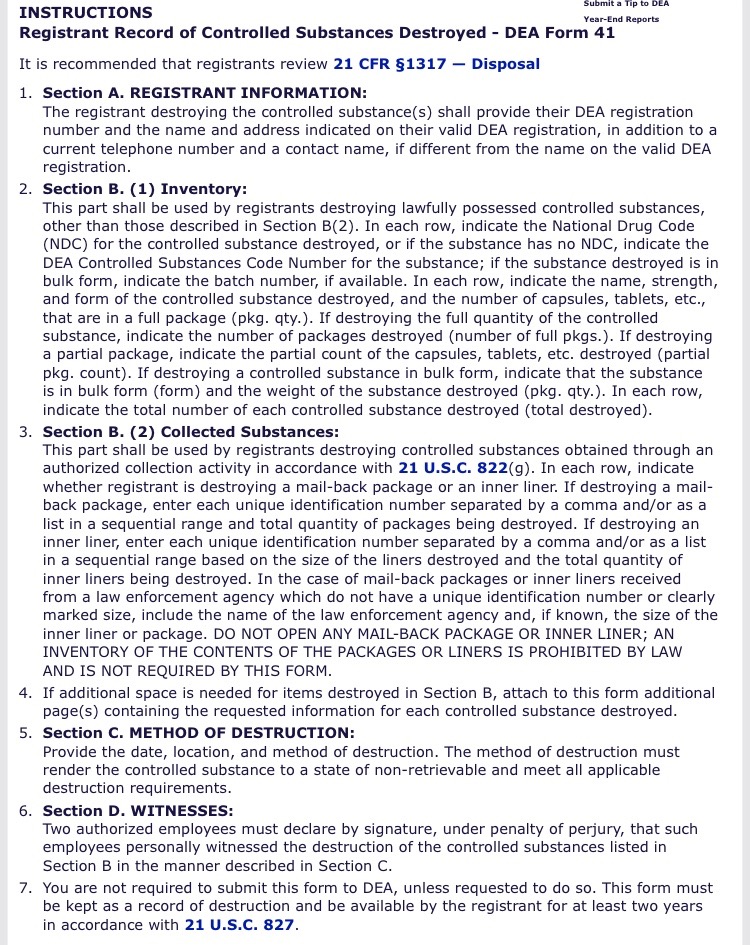
DEA Form 41: Destruction of Controlled Substances

Two Methods:

1. Request DEA authorization to destroy damaged, outdated, and/or unwanted controlled substances 

Once per calendar year for retail pharmacies through the nearest DEA Division Field Office

Complete DEA Form 41 (Registrant’s Inventory of Drugs Surrendered)

Write a letter to the DEA to request permission to destroy, including: date and method of destruction, names of 2 people who will be witnesses (physician, pharmacist, physician assistant, nurse practitioner, nurse or law enforcement officer)

Send letter and DEA Form 41 at least 2 weeks prior to proposed destruction date and await written decision

Once destroyed, signed and completed copies of DEA Form 41 must be forwarded to the DEA

Exception to prior authorization: If a member of a state law enforcement authority or regulatory agency witnesses the destruction, then prior authorization from the nearest DEA Diversion Field Office or local DEA Special Agent in Charge is not required

Copies of a DEA Form 41 or state controlled substance destruction form must be forwarded to the local DEA Diversion Field Office after the destruction

2. Forward controlled substances to a DEA registered distributor who handles the disposal of drugs

Can be done at anytime

Local DEA Division Field Office can provide an updated list of distributors

The distributor must issue a DEA Form 222 to the pharmacy if CII medications are included

For CIII-CV, the pharmacy should document drug name, dose form, strength, quantity and date transferred in writing 

The DEA registered distributor who will destroy the controlled substances is then responsible for submitting DEA Form 41 to the local DEA Diversion Office

Hospital/Institution Pharmacy Controlled Substances

Must keep records of dispensing, destruction, disposal including:

Patient name with date of birth or medical record number as second identifier

Drug name, dose and dose form

Prescriber

Name of individual that dispenses

Name of individual that administers

Date and time of administration

Name of witness observing disposal of unused drug 

“Blanket Authorization”

Issued on a very limited basis for registrants associated with hospitals, clinics or others needing to dispose of used needles, syringes and other injectable objects only

Granted due to the contamination by hazardous body fluids

Requests for ”blanket authorization” are based on: 

Frequency of destruction and volume involved

Method of destruction – must be incinerated or other method involving complete destruction

Registrant’s history 

Security at the pharmacy or registered location

Name and title of the person responsible for destruction

Must still complete a DEA Form 41

Source: deadiversion.usdoj.gov

Link to DEA Form 41: https://www.deadiversion.usdoj.gov/21cfr_reports/surrend/41_form.pdf