My tests had several questions that referenced to the drug approval process. I suggest that anyone planning to take the MPJE for any state be familiar with the drug approval processes
First and only FDA-approved prescription cannabidiol (CBD)
What is it used for?
Seizures associated with Lennox-Gastaut syndrome (LGS), Dravet syndrome or tuberous sclerosis complex (TSC)
Mechanism of action for the reduction of seizures is unknown.
How is it dosed and taken?
Titrated dosing given orally or via feeding tube (non PVC) twice daily, administered consistently with or without food.
LGS or Dravet syndrome:
Initial dose: 5mg/kg/day (2.5mg/kg twice daily)
Recommended dosing: 10 to 15mg/kg/day (5 to 7.5mg/kg twice daily) increased in weekly increments of 5mg/kg/day (2.5mg/kg twice daily)
Maximum dosing: 20mg/kg/day (10mg/kg twice daily)
TSC:
Initial dose: 5mg/kg/day (2.5mg/kg twice daily)
Recommended dosing: 10 to 20mg/kg/day (5 to 10mg/kg twice daily) increased in weekly increments of 5mg/kg/day (2.5mg/kg twice daily)
Maximum dosing: 25mg/kg/day (12.5mg/kg twice daily)
If rapid titration is necessary, dose may be increased no more frequently than every other day.
Dose adjustment and a slower titration is recommended in patients with moderate to severe hepatic impairment.
Should not be stopped suddenly due to the risk of increased frequency of seizures and status epilepticus.
Recommended lab work:
Transaminase and bilirubin levels prior to starting treatment, at month 1, month 3 and month 6 then periodically thereafter.
Patients on valproate or are at increased risk of elevated transaminase levels and/or hepatocellular injury.
If levels are elevated, consider a dose reduction or discontinuation of Epidiolex or other medications known to increase transaminase levels such as valproate and/or clobazam.
Common side effects (> 10% and greater than placebo): transaminase elevations, somnolence, fatigue, malaise, asthenia, decreased appetite, diarrhea, vomiting, pyrexia, rash, insomnia and infections.
Other important side effects to be aware of: suicidal behavior and ideation
Potential interactions to consider:
Several potential drug-drug interactions to consider, most commonly run into potential drug-drug interactions with other anticonvulsant medications:
Clobazam, diazepam, & valproate
Recommended to counsel patient or caregiver on signs/symptoms to watch for and recommend lab work as appropriate.
Strawberry flavored but does not contain strawberry.
Compatible with a ketogenic diet.
Federal law no longer considers Epidiolex to be a controlled substance. It had originally been federally scheduled as a CV. Now it is federally non-controlled. There are a handful of states that have it scheduled as a controlled substance.
It’s a great idea to consider some other state specific controlled substance regulations. Some of these may be:
State Controlled Substance Monitoring Program
Not all states, however most states have a controlled substance monitoring program that allows prescribers and pharmacists to evaluate a patient’s prescription drug history. Each state can specify what information is reportable, how soon after dispensing it must be reported, how it is reviewed and documented, which medications are included, specific exemptions and how long records must be kept. Some states also require a zero report be filed even if a pharmacy does not dispense controlled substances.
State Specific Controlled Substances
Some states designate a medication as a controlled substance or a stricter class of controlled substance even if federal law does not. Some examples of medications to look at for this are: growth hormone, HCG, testosterone, Epidiolex (cannabidiol), Neurontin (gabapentin), Ultam (tramadol), butalbital containing products, Donnatol (phenobarbital and belladonna alkaloids), Librax (chlordiazepoxide and clinidium), ephedrine, pseudoephedrine, Soma (carisoprodol), etc.
Mid-Level Practitioners Prescribing Authority
Prescriber authority for mid-level practitioners such as nurse practitioners or physician assistants can vary state to state. Some are limited as to what controls they may prescribe, day supply allowed, what setting they may prescribe in, etc. The button below is a link to the DEA website that provides a listing by state.
Some states allow pharmacists to dispense Naloxone without a prescription under a collaborative practice agreement, statewide protocol or standing order. There are different limitations and documentation required state to state.
When taking the exam it’s important to read each question carefully and concentrate on which law, general concept or principle the question is testing.
When a drug name is given in a question, identify if it is OTC, prescription only or a controlled substance. Then, use that information to determine which laws apply and how they apply to the question at hand.
Always remember, state law may be stricter and if so STATE LAW APPLIES.
Preparations containing limited quantities of certain narcotics
Generally used for antidiarrheals, antitussives, and analgesic purposes
Examples: Cough preparations with ≤ 200mg of codeine per 100mL or 100g (Robitussin AC, Phenergan with Codeine), Lomotil, Lyrica
CIII-CV Valid Types of Prescriptions
Written signed prescription
Fax of written prescription
Erx
Verbal
Containing all information except prescriber signature
Transfer
ONE TIME for the purpose of REFILL dispensing
Pharmacies electronically sharing a real-time system may transfer up to max refills permitted by law and prescription
CIII-CIV Refills (and CV in Most States)
No more than 5 refills within a 6 month period
Must keep information on the back of the original prescription or in a computerized record-keeping system
Must be accessible within 48 hours
Must record: Prescriber name, Name and address of the patient, Quantity dispensed on each refill, Date of dispensing for each refill, Name or ID code of the dispensing pharmacist and Number of the original prescription order
CIII-CV Partial Filling
Partial filling is allowed
Each partial should be recorded in the same manner as a refill
The total quantity dispensed in all partial fillings cannot exceed the total quantity prescribed
No dispensing may occur beyond 6 months after the date Rx was written
Filling a CV Without a Prescription/Limitations
Only a pharmacist may dispense an over the counter CV
A non-pharmacist may complete the money transfer at the register
Purchaser must be ≥ 18 years old (Rph can require proof of age)
Furnish identification
Bound record book must be maintained by the pharmacist: Name and address of the purchaser, Name and quantity of the CV purchased, Date of purchase, Name or initials of pharmacist that dispensed, Records must be kept for 2 years
Not more than _______ in a 48 hourperiod to the same purchaser
240mL (8 ounces) of any controlled substance containing opium
48 dosage units of any such controlled substance containing opium
120mL (4 ounces) of any other controlled substance
24 dosage units of any other controlled substance
Therefore, MAX is 4 fluid ounces of codeine containing cough syrup over the counter to a given purchaser in a 48 hour period.
When taking the exam it’s important to read each question carefully and concentrate on which law, general concept or principle the question is testing.
When a drug name is given in the question identify if it is OTC, prescription only or a controlled substance. Use that information to determine which laws apply and how they apply to the question at hand.
Always remember, state law may be stricter and if so STATE LAW APPLIES.
I used to be intimidated at the thought of committing to career advancement. I felt overwhelmed by the options available. I didn’t know where to start, what interested me or where I should direct my time and energy. I was afraid of the potential time commitment and navigating the application processes.
I took my first steps into career advancement by signing up to obtain additional state pharmacist licenses. The process was easier and smoother than I had expected it to be. I thought it would be difficult to study and prepare while working full time and taking care of family commitments. I carved out time to study around our family commitments in the late evening, early morning and even during my kid’s activities (ALL the sports practices!).
There are so many options to consider! There are certificate programs, board specialties, licenses, and other educational opportunities. Any pharmacist can find their niche for career advancement. I recommend making sure any certification or specialization is being offered through a reputable organization. ASHP and APhA offer certificate programs. There are websites dedicated to the board specialties. Other educational opportunities may be found through online colleges or local colleges. I have included links below.
Certification Programs to consider:
Pain Management
Pediatrics
Diabetes Management
Medication Reconciliation
Pharmacy Revenue Cycle Management
Pharmacokinetics
Medication Safety
Emergency Medicine
Nutrition Support
Sterile Compounding
Sterile Product Preparation Institutional Training
Look for your dream job online, then review that position’s list of required and preferred qualifications, skills, abilities and requirements. This can be a great starting place to find out what you need to do to get where you want to be.
Lastly, I don’t want to downplay the power of networking. It can be VITAL, especially if you wish to find a position at a new company or in a different industry.
1. Request DEA authorization to destroy damaged, outdated, and/or unwanted controlled substances
Once per calendar year for retail pharmacies through the nearest DEA Division Field Office
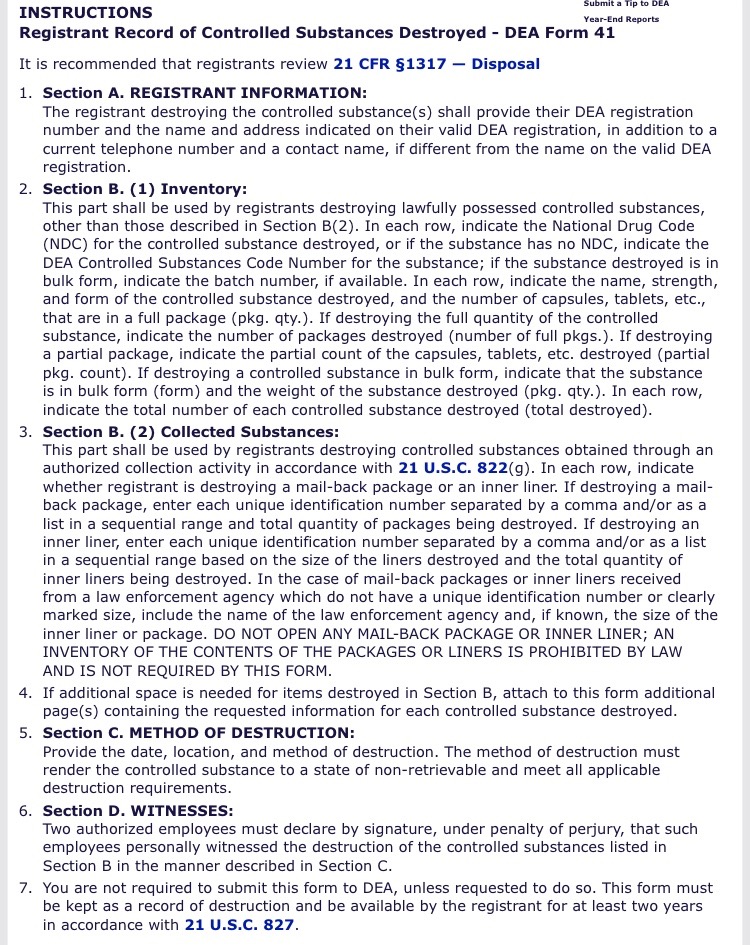
Complete DEA Form 41 (Registrant’s Inventory of Drugs Surrendered)
Write a letter to the DEA to request permission to destroy, including: date and method of destruction, names of 2 people who will be witnesses (physician, pharmacist, physician assistant, nurse practitioner, nurse or law enforcement officer)
Send letter and DEA Form 41 at least 2 weeks prior to proposed destruction date and await written decision
Once destroyed, signed and completed copies of DEA Form 41 must be forwarded to the DEA
Exception to prior authorization: If a member of a state law enforcement authority or regulatory agency witnesses the destruction, then prior authorization from the nearest DEA Diversion Field Office or local DEA Special Agent in Charge is not required
Copies of a DEA Form 41 or state controlled substance destruction form must be forwarded to the local DEA Diversion Field Office after the destruction
2. Forward controlled substances to a DEA registered distributor who handles the disposal of drugs
Can be done at anytime
Local DEA Division Field Office can provide an updated list of distributors
The distributor must issue a DEA Form 222 to the pharmacy if CII medications are included
For CIII-CV, the pharmacy should document drug name, dose form, strength, quantity and date transferred in writing
The DEA registered distributor who will destroy the controlled substances is then responsible for submitting DEA Form 41 to the local DEA Diversion Office
Must keep records of dispensing, destruction, disposal including:
Patient name with date of birth or medical record number as second identifier
Drug name, dose and dose form
Prescriber
Name of individual that dispenses
Name of individual that administers
Date and time of administration
Name of witness observing disposal of unused drug
“Blanket Authorization”
Issued on a very limited basis for registrants associated with hospitals, clinics or others needing to dispose of used needles, syringes and other injectable objects only
Granted due to the contamination by hazardous body fluids
Requests for ”blanket authorization” are based on:
Frequency of destruction and volume involved
Method of destruction – must be incinerated or other method involving complete destruction
Registrant’s history
Security at the pharmacy or registered location
Name and title of the person responsible for destruction
An order may be partially filled within 60 days (expires at 60 days).
Purchaser notes the quantity recieved and date on Blue Copy 3 when receiving their order.
For Federal DEA purposes these records need to be kept for 2 years (some states may require longer).
Any unused forms must be returned to the DEA.
Lost or stolen forms should be reported to the Special Agent in Charge of the DEA in the Divisional office responsible for the area.
For reverse distributors, using the triplicate form process, pharmacy would receive Copy 1 and Copy 2 of the triplicate form, keeping Copy 1 and mailing Copy 2 to the local DEA office.
DEA Legal Amendment to Update to a Single-Sheet Format for DEA 222
SUMMARY: The Drug Enforcement Administration (DEA) is amending its regulations to implement a new single-sheet format for DEA Form 222, used by DEA registrants to order schedules I and II controlled substances. The rule provides for a two-year transition period, during which the existing triplicate version of the forms may continue to be used. The rule also includes a number of minor procedural changes.
Any triplicate forms on hand may be used until October 30, 2021.
Once triplicate forms on hand have been used, the DEA will begin sending single sheet DEA 222 Forms instead of the triplicate forms.
If any triplicate forms are still on hand on October 30, 2021, they should be sent into the Registration Section at DEA Headquarters and the single-sheet form should begin being used.
Since there is no longer a triplicate portion to keep at the pharmacy, the pharmacy will need to make a copy of the new single-sheet DEA 222 form either as a hard copy or electronic copy. Pharmacy will still need to document the quantity received and the date received at the pharmacy.
For Federal DEA purposes these records need to be kept for 2 years (some states may require longer).
The DEA 222 process has also been updated for reverse distributors. With the triplicate form process, pharmacy would receive Copy 1 and Copy 2 of the triplicate form, keeping Copy 1 and mailing Copy 2 to the local DEA office. With the single-sheet DEA 222 Form, pharmacy will receive the single copy, then make a copy and send it to the local DEA office. It is still required to document the quantity shipped and date shipped on the order form.
CSOS: Controlled Substance Ordering System
CSOS is the computerized system used for ordering controlled substances.
CSOS orders can include scheduled I-V and non-controlled.
If CSOS is down or the CSOS account is closed, then a paper form will be required to order.
Source: DEA website
1. An individual enrolls with DEA and, once approved, is issued a personal CSOS Certificate.
2. The purchaser creates an electronic 222 order using an approved ordering software. The order is digitally signed using the purchaser’s personal CSOS Certificate and then transmitted to the suppliers. The paper 222 is not required for electronic ordering.
3. The supplier receives the purchase order and verifies that the purchaser’s certificate is valid with DEA. Additionally, the supplier validates the electronic order information just like it would a paper order.
4. The supplier completes the order and ships to the purchaser. Any communications regarding the order are sent electronically.
5. The order is reported by the supplier to DEA within two business days
Above graphic and list is provided from the DEAecom.gov website.
Distribution shall be recorded by distributing and receiving pharmacies or practitioners. Receipts are to include: the controlled substance name, dosage form, dosage units in each container and number of containers ordered and received for record keeping.
If the controlled substance is a Schedule I or II, a DEA 222 must be used for the transaction.
Total number distributed during the calendar year shall not exceed 5% of the total number of all controlled substances during the same calendar year.
If number distributed will exceed 5% must obtain a registration to distribute controlled substances (i.e., wholesaler’s permit).
A PRESCRIBER MAY NOT WRITE A PRESCRIPTION FOR “OFFICE USE”.
All locations that manufacturer, distribute or dispense controlled substances must register with the DEA with the exception of:
Warehouses used for storage of controlled substance by registrants
A prescriber’s office where controlled substances are prescribed – not administered or dispensed.
Freight delivery companies
A location where sales of controlled substances are made, solicited or supervised, but the location does not actually keep controlled substances on site
DEA registrations are valid for 36 months.
Renewal forms are sent to the registrant 60 days before the current registration expires.
Registrant must contact the DEA in writing if they do not receive their renewal forms within 45 days before the current registration expires.
The DEA may deny or revoke a registration if:
Information on the application is untrue
Applicant has been convicted of a drug-related felony
Registration would be inconsistent with the public interest
State license has been suspended, revoked or denied
May also revoke license if applicant is excluded from Medicare or state health program participation
Federal law does NOT require the applicant for DEA registration to be a pharmacist.
Hospital registrations are treated as an “institutional practitioner” and DEA registration is issued to the entire hospital.
Power of Attorney
An applicant may authorize another individual or individuals to sign official forms by filing with the Registration Unit of the DEA, a Power of Attorney for each authorized individual. It remains valid until revoked with a Notice of Revocation.