Equivalence and Substitution

Regulations fall within the jurisdiction of the individual states.

Pharmaceutical equivalence: same active ingredient, same dosage form, same route of administration, identical in dosage strength or concentration, may contain different excipients 

Therapeutic equivalence:  pharmaceutical equivalence and bioequivalent 

Bioequivalence | ADME

A = absorption

D = distribution

M = metabolism

E = elimination 

The manufacturer must submit graphs to the FDA illustrating the two products containing the same drug have similar blood concentration vs. time curves, including: 

Time to peak

Peak concentrations

Area under the curve (AUC)

References

Approved Drug Products with Therapeutic Equivalence Evaluations aka The Orange Book

The Electronic Orange Book (internet version)

United States Pharmacopeia Dispensing Information (USP/DI) Volume III plus supplements 

Facts and Comparisons, Inc Approved Bioequivalence Codes 

FDA’s Internet Website http://www.fda.gov

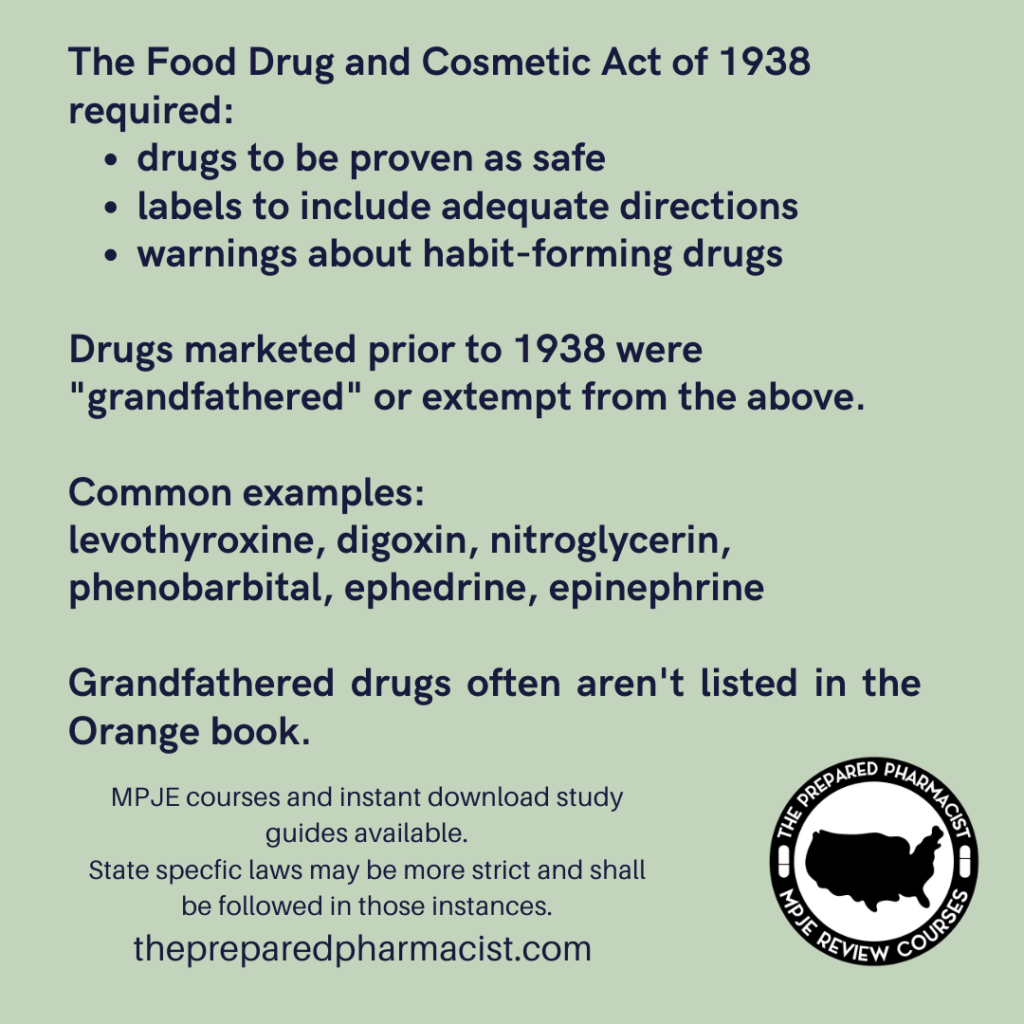
Drugs marketed before 1938 are not required to be in The Orange Book.

A Rated

Bioequivalent to the innovator’s drug product 

Therapeutically equivalent to the brand name or reference product

A-rated products may be substituted for one another.

B Rated

NOT bioequivalent to the innovator’s drug product 

B-rated products may not be substituted for one another.

Generally, a tablet cannot be substituted for a capsule, an ointment for a cream.  Most sustained-release or controlled-release are not interchangeable. 

AB Rated

Previously not considered to be bioequivalent and now organized into bioequivalence groups (AB1, AB2, AB3, etc)

Must have the same number or lack of number to be bioequivalent 

Cannot substitute an AB1 product for a product designated as AB2

The Federal government has not passed regulations limiting the substitution of these products although a few states have.

Examples:

Carbamazepine

Digoxin

Levothyroxine

Lithium

Phenytoin

Theophylline

Valproic acid

Warfarin
Checkout our self-guided courses and instant download study guides on Teachable for Texas, Iowa, Maryland and federal law!

What are grandfathered medications?

The Food Drug and Cosmetic Act of 1938

The Food Drug and Cosmetic Act of 1938 (FDCA) required medications be proven safe when used according to the directions on the label prior to marketing. It also required that labels include adequate directions for use. The Food Drug and Cosmetic Act of 1938 also requires habit-forming drugs to include a warning of the habit forming risk. Drugs already marketed prior to 1938 were exempt or “grandfathered” and did not require a change to their labeling or safety studies under this law. This was the first law that included cosmetics and medical devices into medication and food legislation. The FDCA also defined a dietary ingredient as “a vitamin, mineral, herb, or other botanical, amino acid, a dietary substance to supplement the diet by increasing the total dietary intake, or a concentrate, metabolite, constituent, extract, or combination of any of the aforementioned ingredients”. The FDCA also established the Homeopathic Pharmacopoeia of the United States (HPUS) as an official compendium, requiring drug products using an official listed name to meet all of its standards (otherwise would be considered misbranded or adulterated). This Act became the groundwork for further amendments and subsequent laws regarding drug legislation in the United States. Other specifications in the FDCA include the medications below.

Ipecac Syrup

Reminder: Ipecac Fluid Extract is not the same as Ipecac Syrup. Ipecac Fluid Extract is 14 times as potent as Ipecac Syrup!

Must have a statement boxed and in red text that states “For emergency use to cause vomiting in poisoning. Before using, call physician, the poison prevention center, or hospital emergency room immediately for advice.”

Must carry the statement “Warning: Keep out of reach of children. Do not use in unconcious persons or for poisoning involving corrosives (lye, strong acids), petroleum distillates such as kerosine, gasoline, cleaning fluids, or for strychnine”.

The usual dosage is 1 Tbsp or 15mL in patients over one year of age.

Ipecac syrup is only able to be sold in 1 oz or 30mL containers.

The FDCA also requires that certain drugs and adjuvants carry special warning labels. Examples are:

FD&C Yellow No. 5 (tartrazine)

Labeling must list in the precautions and specify that it may cause allergic reactions in some individuals

Aspartame

Labeling must carry a warning of “Phenylketonurics: Contains phenylalanine _x_ mg per _x_ (dosage unit)”

Sulfites

Labeling must contain an allergy warning in the labeling of prescription drugs and wines

Mineral Oil

Labeling must contain a warning that it should be used at bedtime, warn that it not be used in infants unless under the direction of a physician and should discourage use in pregnant women

Wintergreen oil (methyl salicylate) in amounts > 5%

Labeling should warn to keep out of the reach of children and also warn that using other than how directed may be dangerous

Sodium phosphate (saline laxative)

Packaging is limited to no more than 90mL per OTC container

Isoproterenol Inhalation Products

Labeling should warn not to exceed the dose prescribed and also warn to get medical assistance and/or contact physician if user continues to have breathing difficulty

Acetophenetidin (Phenacetin)

Labeling must carry a warning about possible kidney damage when taken in large amounts or for long periods of time

Salicylates (includes aspirin)

Labeling must include a warning about Reye’s Syndrome

Alcohol warning

Labeling for analgesics and antipyretics (acetaminophen, aspirin, ibuprofen, naproxen, etc.) are required to warn patients to consult with their physician before taking these medications if they consume ≥ 3 alcoholic beverages per day