Controlled Substances CIII-CV

When taking the exam it’s important to read each question carefully and concentrate on which law, general concept or principle the question is testing.

When a drug name is given in a question, identify if it is OTC, prescription only or a controlled substance. Then, use that information to determine which laws apply and how they apply to the question at hand.

Always remember, state law may be stricter and if so STATE LAW APPLIES.

CIII Medications

Drugs with Moderate to Low Potential for Physical and Psychological Dependence

Combination products containing less than 90mg of codeine per dosage unit (Tylenol with codeine)

Fiorinal is CIII however Fioricet is non-controlled

  Fiorinal: ASA 325mg/butalbital 50mg/caffeine 40mg

  Fioricet: APAP 325mg/butalbital 50mg/caffeine 40mg

buprenorphine (Suboxone)benzphetamine (Didrex)
ketaminephendimetrazine
anabolic steroidsThiopental
testosteroneFiorinal
CIII medications

CIV Medications

Drugs with Low Potential for Abuse or Dependence
alprazolam (Xanax)diazepam (Valium)
carisoprodol (Soma)lorazepam (Ativan)
clonazepam (Klonopin)midazolam (Versed)
clorazepate (Tranxene)temazepam (Restoril)
triazolam (Halcion)phenobarbital
butorphanol
CIV Medications

CV Medications

Drugs with Lower Potential for Abuse 

Preparations containing limited quantities of certain narcotics

Generally used for antidiarrheals, antitussives, and analgesic purposes

Examples: Cough preparations with ≤ 200mg of codeine per 100mL or 100g (Robitussin AC, Phenergan with Codeine), Lomotil, Lyrica

CIII-CV Valid Types of Prescriptions

Written signed prescription

Fax of written prescription

Erx

Verbal

Containing all information except prescriber signature

Transfer

ONE TIME for the purpose of REFILL dispensing

Pharmacies electronically sharing a real-time system may transfer up to max refills permitted by law and prescription

CIII-CIV Refills (and CV in Most States)

No more than 5 refills within a 6 month period

Must keep information on the back of the original prescription or in a computerized record-keeping system

Must be accessible within 48 hours

Must record: Prescriber name, Name and address of the patient, Quantity dispensed on each refill, Date of dispensing for each refill, Name or ID code of the dispensing pharmacist and Number of the original prescription order

CIII-CV Partial Filling

Partial filling is allowed

Each partial should be recorded in the same manner as a refill

The total quantity dispensed in all partial fillings cannot exceed the total quantity prescribed

No dispensing may occur beyond 6 months after the date Rx was written

Filling a CV Without a Prescription/Limitations

Only a pharmacist may dispense an over the counter CV

A non-pharmacist may complete the money transfer at the register

Purchaser must be ≥ 18 years old (Rph can require proof of age)

Furnish identification 

Bound record book must be maintained by the pharmacist: Name and address of the purchaser, Name and quantity of the CV purchased, Date of purchase, Name or initials of pharmacist that dispensed, Records must be kept for 2 years

Not more than _______ in a 48 hourperiod to the same purchaser

240mL (8 ounces) of any controlled substance containing opium

48 dosage units of any such controlled substance containing opium

120mL (4 ounces) of any other controlled substance

24 dosage units of any other controlled substance

Therefore, MAX is 4 fluid ounces of codeine containing cough syrup over the counter to a given purchaser in a 48 hour period.

Check out the detailed information in our guided course and downloadable study guides on Teachable.

Controlled Substances CII

When taking the exam it’s important to read each question carefully and concentrate on which law, general concept or principle the question is testing.  

When a drug name is given in the question identify if it is OTC, prescription only or a controlled substance. Use that information to determine which laws apply and how they apply to the question at hand.

Always remember, state law may be stricter and if so STATE LAW APPLIES.

Drugs with a high potential for abuse
Potential to lead to severe psychological or physical dependence
Dangerous
hydromorphone (Dilaudid) fentanyl (Sublimaze, Duragesic)hydrocodoneamobarbital
methadone (Dolophine)morphineamphetamine (Dexedrine, Adderall)glutethimide
meperidine (Demerol)opiummethamphetamine (Desoxyn)pentobarbital 
oxycodone (OxyContin, Percocetcodeinemethylphenidate (Ritalin)secobarbital
CII Controlled Substances

Barbiturates

Amobarbital (Amytal), pentobarbital (Nembutal) and secobarbital (Seconal) are CIIs.

Phenobarbital (Luminal) is a CIV.

Hydrocodone

Hydrocodone was reclassified to CII in 2014.

CII Prescription Requirements: Valid Types of Prescriptions

Written signed prescription

Erx

Oral (ONLY in emergency)

Fax (ONLY if home infusion, long term care facility, hospice)

CII Prescriptions: What Can be Changed?

Patient address (can also obtain from patient)

Drug strength

Dosage form

Drug quantity

Directions

CII Prescriptions: What Cannot be Changed?

Patient’s Name

Controlled substance prescribed

Prescriber’s Signature

⬆️ Any of the above items would require a new prescription.

CII Prescriptions: Partial Filling

No refills are allowed on CII prescriptions

Partial may be dispensed: 

*If it is not prohibited by State laws*

The partial fill is requested by the patient or the practitioner who wrote the prescription.

The total quantity dispensed in all partial fillings does not exceed the total quantity prescribed.

Within 30 days of the date on which the prescription was written 

Exception: Terminal patients may get a partial dispense and prescription is void 60 days after written

Partial dispense prescription documentation:

Date of partial fill

Quantity dispensed

Remaining quantity

Dispensing pharmacist

Check out the detailed information in our guided course and downloadable study guides on Teachable!!

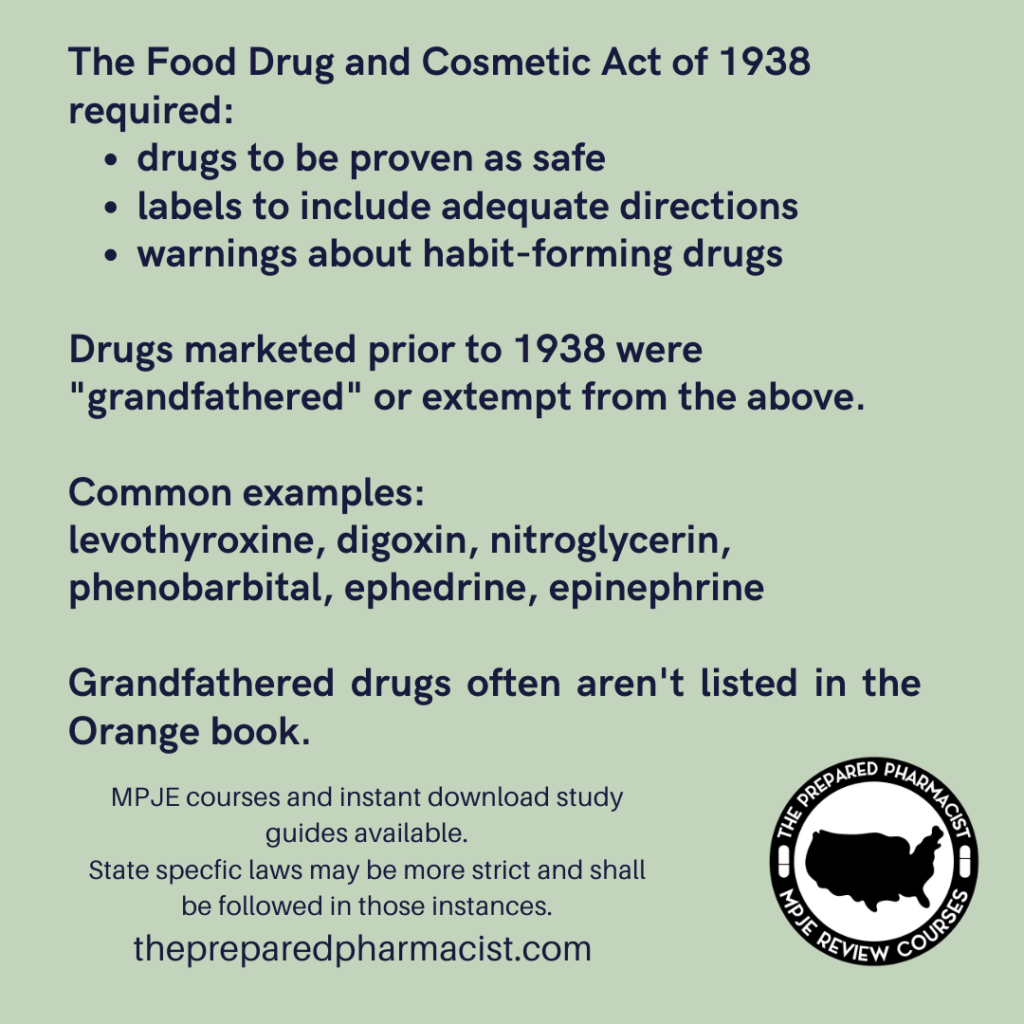
What are grandfathered medications?

The Food Drug and Cosmetic Act of 1938

The Food Drug and Cosmetic Act of 1938 (FDCA) required medications be proven safe when used according to the directions on the label prior to marketing. It also required that labels include adequate directions for use. The Food Drug and Cosmetic Act of 1938 also requires habit-forming drugs to include a warning of the habit forming risk. Drugs already marketed prior to 1938 were exempt or “grandfathered” and did not require a change to their labeling or safety studies under this law. This was the first law that included cosmetics and medical devices into medication and food legislation. The FDCA also defined a dietary ingredient as “a vitamin, mineral, herb, or other botanical, amino acid, a dietary substance to supplement the diet by increasing the total dietary intake, or a concentrate, metabolite, constituent, extract, or combination of any of the aforementioned ingredients”. The FDCA also established the Homeopathic Pharmacopoeia of the United States (HPUS) as an official compendium, requiring drug products using an official listed name to meet all of its standards (otherwise would be considered misbranded or adulterated). This Act became the groundwork for further amendments and subsequent laws regarding drug legislation in the United States. Other specifications in the FDCA include the medications below.

Ipecac Syrup

Reminder: Ipecac Fluid Extract is not the same as Ipecac Syrup. Ipecac Fluid Extract is 14 times as potent as Ipecac Syrup!

Must have a statement boxed and in red text that states “For emergency use to cause vomiting in poisoning. Before using, call physician, the poison prevention center, or hospital emergency room immediately for advice.”

Must carry the statement “Warning: Keep out of reach of children. Do not use in unconcious persons or for poisoning involving corrosives (lye, strong acids), petroleum distillates such as kerosine, gasoline, cleaning fluids, or for strychnine”.

The usual dosage is 1 Tbsp or 15mL in patients over one year of age.

Ipecac syrup is only able to be sold in 1 oz or 30mL containers.

The FDCA also requires that certain drugs and adjuvants carry special warning labels. Examples are:

FD&C Yellow No. 5 (tartrazine)

Labeling must list in the precautions and specify that it may cause allergic reactions in some individuals

Aspartame

Labeling must carry a warning of “Phenylketonurics: Contains phenylalanine _x_ mg per _x_ (dosage unit)”

Sulfites

Labeling must contain an allergy warning in the labeling of prescription drugs and wines

Mineral Oil

Labeling must contain a warning that it should be used at bedtime, warn that it not be used in infants unless under the direction of a physician and should discourage use in pregnant women

Wintergreen oil (methyl salicylate) in amounts > 5%

Labeling should warn to keep out of the reach of children and also warn that using other than how directed may be dangerous

Sodium phosphate (saline laxative)

Packaging is limited to no more than 90mL per OTC container

Isoproterenol Inhalation Products

Labeling should warn not to exceed the dose prescribed and also warn to get medical assistance and/or contact physician if user continues to have breathing difficulty

Acetophenetidin (Phenacetin)

Labeling must carry a warning about possible kidney damage when taken in large amounts or for long periods of time

Salicylates (includes aspirin)

Labeling must include a warning about Reye’s Syndrome

Alcohol warning

Labeling for analgesics and antipyretics (acetaminophen, aspirin, ibuprofen, naproxen, etc.) are required to warn patients to consult with their physician before taking these medications if they consume ≥ 3 alcoholic beverages per day