DEA Applications and Forms

The DEA applications, renewals and forms were on every MPJE I have taken in one way or another.

Over the next several weeks we will do a deeper dive into each type of application and renewal or form to learn the details.

Basics

What is the DEA?

Stands for Drug Enforcement Administration

Part of the United States Department of Justice

Responsible for the Controlled Substances Act

Those who are authorized to possess controlled substances must be registered by the DEA. 

Pharmacists typically do not need to register individually with the DEA if they are working in a registered organization.  

Adulterated and Misbranded – What is the Difference?

ADULTERATED medications have an issue related to the COMPOSITION.

MISBRANDED medications have an issue with the LABELING.

Adulterated:

Contains any substance that is decomposing, filthy or putrid

Manufactured, packaged or stored in unsanitary conditions that may have caused contamination

Not manufactured under Good Manufacturing Practices (GMPs)

Contains a color additive that is unapproved

Contains a drug whose strength, purity or quality is lower than the official standards in the compendia

Contains a drug whose strength, purity or quality is lower than listed on the label

Container is made of a substance that leaches into the product

Contains any other ingredient as a substitute for the active drug listed

Misbranded:

Label has incorrect information or is misleading

Label does not list the name and location of the manufacturer, packer or distributor

Label does not contain a statement, word or any other information that is required by law

Label does not list the established name of the active drug

Label does not list each active drug ingredient

Label does not contain the “Rx Only” statement if the drug is only available by prescription (this is not required on the prescription label if dispensing to an outpatient consumer)

Label does not contain a precautionary statement for a medication that is at risk of deterioration

Label does not include the quantity of the container contents (such as count of 100, weight of 50g, or volume of 4 fl. oz.)

Non-prescription drug label does not contain adequate directions for use or appropriate warnings to protect consumers using the medication or packaging

Label is not in compliance with USP (US Pharmacopeia) and/or NF (National Formulary) specifications

Labeling offers one drug for sale under the name of a different drug

Pharmacy dispenses a prescription only medication without having a legal prescription or an authorized refill

Good Manufacturing Practices (GMPs)

Regulations that identify the minimum standards for manufacturing pharmaceuticals in the United States with the goal of safe and quality medications. Compliance is the responsibility of manufacturers. Manufacturers must be registered with the FDA, describe their manufacturing and production processes in their NDA (new drug application) process, and be inspected regularly. Inspections are typically every 2 years unless prior deficiencies warrant more frequent inspections.

Labeling

Labeling includes writing, print and/or graphics the immediate container of a medication and the outer container. If there is an outer container, labeling on the inner product must also appear on the outside container.

The package insert is considered part of the labeling.

The prescription label created by the pharmacist is also included in labeling.

What are grandfathered medications?

The Food Drug and Cosmetic Act of 1938

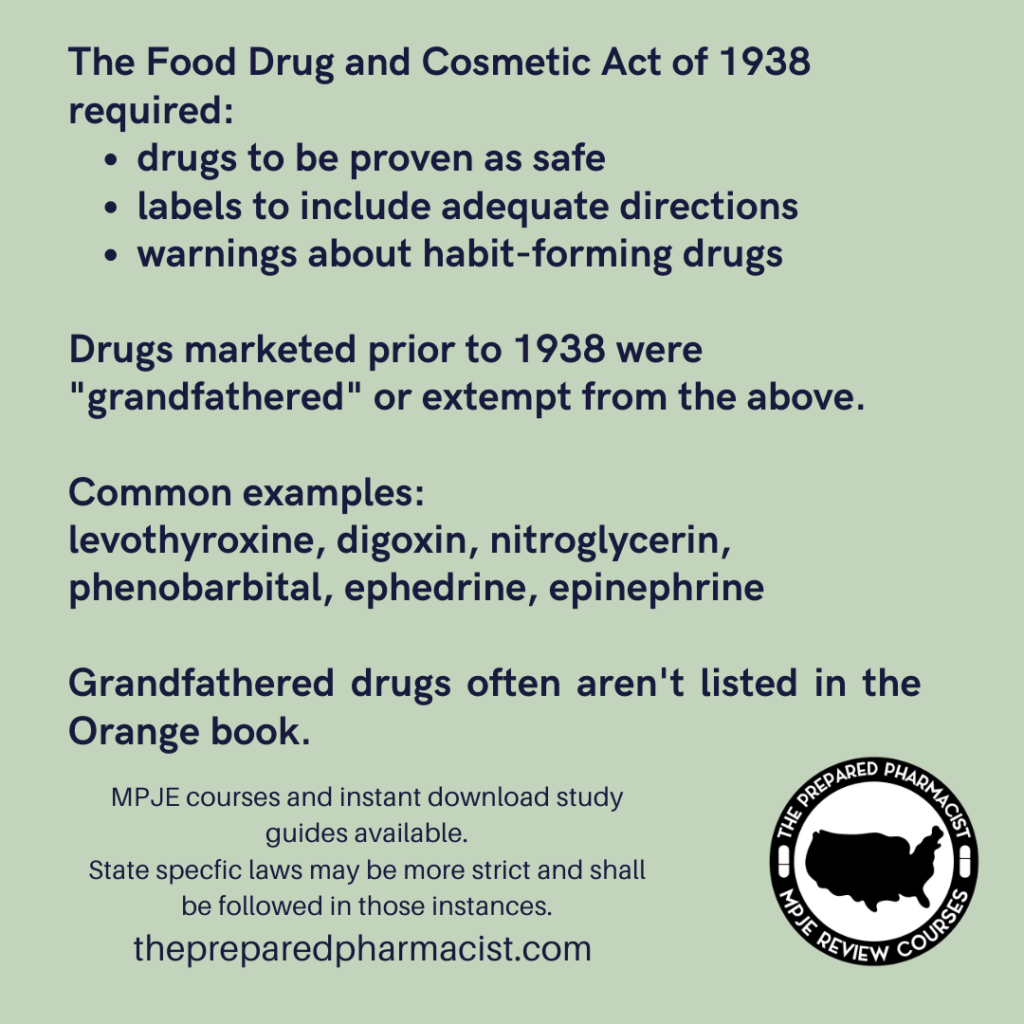
The Food Drug and Cosmetic Act of 1938 (FDCA) required medications be proven safe when used according to the directions on the label prior to marketing. It also required that labels include adequate directions for use. The Food Drug and Cosmetic Act of 1938 also requires habit-forming drugs to include a warning of the habit forming risk. Drugs already marketed prior to 1938 were exempt or “grandfathered” and did not require a change to their labeling or safety studies under this law. This was the first law that included cosmetics and medical devices into medication and food legislation. The FDCA also defined a dietary ingredient as “a vitamin, mineral, herb, or other botanical, amino acid, a dietary substance to supplement the diet by increasing the total dietary intake, or a concentrate, metabolite, constituent, extract, or combination of any of the aforementioned ingredients”. The FDCA also established the Homeopathic Pharmacopoeia of the United States (HPUS) as an official compendium, requiring drug products using an official listed name to meet all of its standards (otherwise would be considered misbranded or adulterated). This Act became the groundwork for further amendments and subsequent laws regarding drug legislation in the United States. Other specifications in the FDCA include the medications below.

Ipecac Syrup

Reminder: Ipecac Fluid Extract is not the same as Ipecac Syrup. Ipecac Fluid Extract is 14 times as potent as Ipecac Syrup!

Must have a statement boxed and in red text that states “For emergency use to cause vomiting in poisoning. Before using, call physician, the poison prevention center, or hospital emergency room immediately for advice.”

Must carry the statement “Warning: Keep out of reach of children. Do not use in unconcious persons or for poisoning involving corrosives (lye, strong acids), petroleum distillates such as kerosine, gasoline, cleaning fluids, or for strychnine”.

The usual dosage is 1 Tbsp or 15mL in patients over one year of age.

Ipecac syrup is only able to be sold in 1 oz or 30mL containers.

The FDCA also requires that certain drugs and adjuvants carry special warning labels. Examples are:

FD&C Yellow No. 5 (tartrazine)

Labeling must list in the precautions and specify that it may cause allergic reactions in some individuals

Aspartame

Labeling must carry a warning of “Phenylketonurics: Contains phenylalanine _x_ mg per _x_ (dosage unit)”

Sulfites

Labeling must contain an allergy warning in the labeling of prescription drugs and wines

Mineral Oil

Labeling must contain a warning that it should be used at bedtime, warn that it not be used in infants unless under the direction of a physician and should discourage use in pregnant women

Wintergreen oil (methyl salicylate) in amounts > 5%

Labeling should warn to keep out of the reach of children and also warn that using other than how directed may be dangerous

Sodium phosphate (saline laxative)

Packaging is limited to no more than 90mL per OTC container

Isoproterenol Inhalation Products

Labeling should warn not to exceed the dose prescribed and also warn to get medical assistance and/or contact physician if user continues to have breathing difficulty

Acetophenetidin (Phenacetin)

Labeling must carry a warning about possible kidney damage when taken in large amounts or for long periods of time

Salicylates (includes aspirin)

Labeling must include a warning about Reye’s Syndrome

Alcohol warning

Labeling for analgesics and antipyretics (acetaminophen, aspirin, ibuprofen, naproxen, etc.) are required to warn patients to consult with their physician before taking these medications if they consume ≥ 3 alcoholic beverages per day

The Poison Prevention Packaging Act

Today’s topic is child-resistant containers and closures.

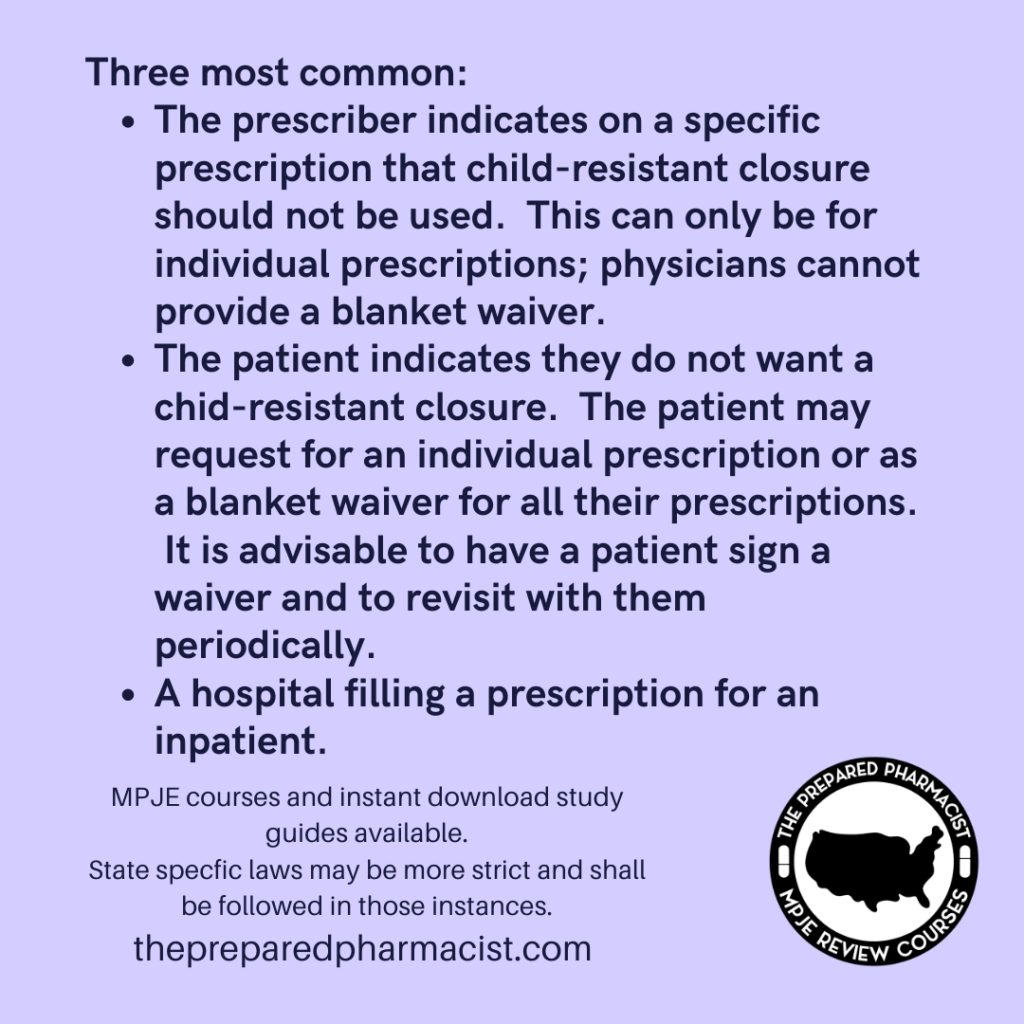
First take away is that physician’s CANNOT provide a blanket order.

Hospital inpatient prescriptions are not required to be child-resistant. Prescriptions filled by a hospital outpatient pharmacy ARE required to be in child-resistant packaging.

Customized patient medication packages (med paks) are not exempt from the Poison Prevention Packaging Act. They must be child-resistant, placed in an outer container that complies or patient must consent to non child-resistant packaging.

There are several medications that themselves are exempt from child-resistant packaging. A few examples are sublingual nitroglycerin, oral contraceptive packages and inhalers.